What is the basic structural difference between starch and cellulose?

Solution and Explanation
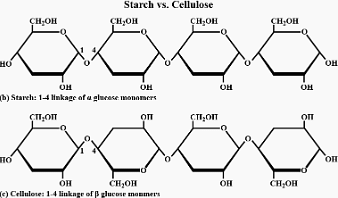
Starch consists of two components - amylose and amylopectin. Amylose is a long linear chain of ∝-D-(+)-glucose units joined by C1-C4 glycosidic linkage (∝-link).
Amylopectin is a branched-chain polymer of ∝-D-glucose units, in which the chain is formed by C1-C4 glycosidic linkage and the branching occurs by C1-C6 glycosidic linkage.
On the other hand, cellulose is a straight-chain polysaccharide of β-D-glucose units joined by C1-C4 glycosidic linkage (β-link).
Top CBSE CLASS XII Chemistry Questions
- ${AgNO_3}$ does not decompose where :
- Azeotropic mixture of water and HCl boils at 381.5 K. By distilling the mixture it is possible to obtain
Write IUPAC names of the following compounds and classify them into primary, secondary and tertiary amines.
(i) (CH3 )2CHNH2 (ii) CH3 (CH2 )2NH2 (iii) CH3NHCH(CH3 )2
(iv) (CH3 )3CNH2 (v) C6H5NHCH3 (vi) (CH3CH2 )2NCH3 (vii) m–BrC6H4NH2
Give one chemical test to distinguish between the following pairs of compounds.
(i) Methylamine and dimethylamine
(ii) Secondary and tertiary amines
(iii) Ethylamine and aniline
(iv) Aniline and benzylamine
(v) Aniline and N-methylanilineAccount for the following:
(i) pKb of aniline is more than that of methylamine.
(ii) Ethylamine is soluble in water whereas aniline is not.
(iii) Methylamine in water reacts with ferric chloride to precipitate hydrated ferric oxide.
(iv) Although amino group is o– and p– directing in aromatic electrophilic substitution reactions, aniline on nitration gives a substantial amount of m-nitroaniline.
(v) Aniline does not undergo Friedel-Crafts reaction.
(vi) Diazonium salts of aromatic amines are more stable than those of aliphatic amines. (vii) Gabriel phthalimide synthesis is preferred for synthesising primary amines.
Top CBSE CLASS XII Biomolecules Questions
- What are monosaccharides?
- What are reducing sugars?
- Write two main functions of carbohydrates in plants.
- Classify the following into monosaccharides and disaccharides.
Ribose,2-deoxyribose,maltose, galactose,fructose and lactose. - What do you understand by the term glycosidic linkage?
Top CBSE CLASS XII Questions
- 2, b, c are in A.P. and the range of determinant $\begin{vmatrix}1&1&1\\ 2&b&c\\ 4&b^{2}&c^{2}\end{vmatrix}$ is [2, 16]. Then find range of c is
- A boy of mass 50 kg is standing at one end of a, boat of length 9 m and mass 400 kg. He runs to the other, end. The distance through which the centre of mass of the boat boy system moves is
- A capillary tube of radius r is dipped inside a large vessel of water. The mass of water raised above water level is M. If the radius of capillary is doubled, the mass of water inside capillary will be
- A circular disc is rotating about its own axis. An external opposing torque 0.02 Nm is applied on the disc by which it comes rest in 5 seconds. The initial angular momentum of disc is
- A circular disc is rotating about its own axis at uniform angular velocity \(\omega.\) The disc is subjected to uniform angular retardation by which its angular velocity is decreased to \(\frac {\omega}{2}\) during 120 rotations. The number of rotations further made by it before coming to rest is
Concepts Used:
Polysaccharides
Polysaccharides are the most abundant hydrocarbons that exist in our food. They are long chains of hydrocarbons inclusive of smaller units called monosaccharides or monomers, related to each other through glycosidic linkages. Cellulose, starch, chitin, and glycogen are the most common polysaccharides found in food.
Characteristics of Polysaccharides:
- Desiccation does not cause Polysaccharides to structure crystals.
- They do not have a candied flavor.
- Water cannot infiltrate the molecules due to the numerous hydrogen bonds, making them hydrophobic.
- They are osmotically inactive and close-packed inside the cells. Many are water-insoluble.
- They are collections of hydrogen, carbon, and oxygen. 2:1 is the ratio of hydrogen to oxygen.
- They are carbohydrates with a molecular weight comparatively more excessive than other compounds. It is also possible to extract a white powder out of it.
Types of Polysaccharides:
- Homopolysaccharides
- Heteropolysaccharides