The electric and magnetic fields of electromagnetic waves are :
Show Hint
- In the same phase and perpendicular to each other.
- In the same phase and not perpendicular to each other.
- Not in the same phase but are perpendicular to each other.
- Neither in the same phase nor perpendicular to each other.

The Correct Option is A
Solution and Explanation
An electromagnetic wave is made of an electric field and a magnetic field that sustain each other as the wave travels. We need their phase relation and their directions.
Step 2: Key Formula or Approach:
For a wave travelling along the x-axis, with the electric field along y and the magnetic field along z:
\[ E_y = E_0 \sin(kx - \omega t), \qquad B_z = B_0 \sin(kx - \omega t) \]
The ratio of the amplitudes is \( E_0/B_0 = c \).
Step 3: Detailed Explanation:
Both fields contain the same term \( (kx - \omega t) \). So they become zero together and reach their maximum together. This means they are in the same phase.
The electric field, the magnetic field and the direction of travel are mutually perpendicular, and \( \vec{E}\times\vec{B} \) points along the direction of propagation. So the two fields are perpendicular to each other.
Step 4: Check the options.
(A) In phase and perpendicular. This is TRUE.
(B) In phase but not perpendicular. FALSE, because the wave is transverse and \( \vec{E} \perp \vec{B} \).
(C) Not in phase but perpendicular. FALSE, because the phase difference is zero. A phase difference of \( \pi/2 \) is seen between voltage and current in ac circuits, not between E and B of a wave.
(D) Neither in phase nor perpendicular. FALSE for both reasons.
Final Answer:
The electric and magnetic fields are in the same phase and perpendicular to each other, option (A). \[ \boxed{\text{(A)}} \]
Top CBSE CLASS XII Physics Questions
- A boy of mass 50 kg is standing at one end of a, boat of length 9 m and mass 400 kg. He runs to the other, end. The distance through which the centre of mass of the boat boy system moves is
- A capillary tube of radius r is dipped inside a large vessel of water. The mass of water raised above water level is M. If the radius of capillary is doubled, the mass of water inside capillary will be
- A circular disc is rotating about its own axis. An external opposing torque 0.02 Nm is applied on the disc by which it comes rest in 5 seconds. The initial angular momentum of disc is
- A circular disc is rotating about its own axis at uniform angular velocity \(\omega.\) The disc is subjected to uniform angular retardation by which its angular velocity is decreased to \(\frac {\omega}{2}\) during 120 rotations. The number of rotations further made by it before coming to rest is
- A constant power is supplied to a rotating disc. The relationship between the angular velocity $\omega$ of the disc and number of rotations (n) made by the disc is governed by
Top CBSE CLASS XII Electromagnetic Waves Questions
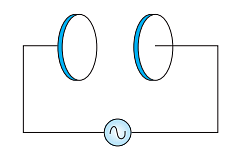
A parallel plate capacitor made of circular plates each of radius R = 6.0 cm has a capacitance C = 100 pF. The capacitor is connected to a 230 V ac supply with a (angular) frequency of 300 rad s−1.
- What is the rms value of the conduction current?
- Is the conduction current equal to the displacement current?
- Determine the amplitude of B at a point 3.0 cm from the axis between the plates.
What physical quantity is the same for X-rays of wavelength \(10^{−10} m\), red light of wavelength \(6800 Å\) and radio waves of wavelength \(500\ m\)?
A plane electromagnetic wave travels in vacuum along z-direction. What can you say about the directions of its electric and magnetic field vectors? If the frequency of the wave is 30 MHz, what is its wavelength?
A radio can tune in to any station in the 7.5 MHz to 12 MHz band. What is the corresponding wavelength band?
A charged particle oscillates about its mean equilibrium position with a frequency of \(10^9 Hz\). What is the frequency of the electromagnetic waves produced by the oscillator?
Top CBSE CLASS XII Questions
- 2, b, c are in A.P. and the range of determinant $\begin{vmatrix}1&1&1\\ 2&b&c\\ 4&b^{2}&c^{2}\end{vmatrix}$ is [2, 16]. Then find range of c is
- A boy of mass 50 kg is standing at one end of a, boat of length 9 m and mass 400 kg. He runs to the other, end. The distance through which the centre of mass of the boat boy system moves is
- A capillary tube of radius r is dipped inside a large vessel of water. The mass of water raised above water level is M. If the radius of capillary is doubled, the mass of water inside capillary will be
- A circular disc is rotating about its own axis. An external opposing torque 0.02 Nm is applied on the disc by which it comes rest in 5 seconds. The initial angular momentum of disc is
- A circular disc is rotating about its own axis at uniform angular velocity \(\omega.\) The disc is subjected to uniform angular retardation by which its angular velocity is decreased to \(\frac {\omega}{2}\) during 120 rotations. The number of rotations further made by it before coming to rest is