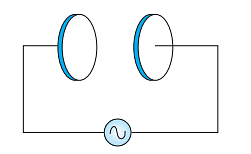
A parallel plate capacitor made of circular plates each of radius R = 6.0 cm has a capacitance C = 100 pF. The capacitor is connected to a 230 V ac supply with a (angular) frequency of 300 rad s−1.
What is the rms value of the conduction current?
Is the conduction current equal to the displacement current?
Determine the amplitude of B at a point 3.0 cm from the axis between the plates.
Radius of each circular plate, R = 6.0 cm = 0.06 m Capacitance of a parallel plate capacitor, C = 100 pF = 100 × 10−12 F Supply voltage, V = 230 V Angular frequency, ω = 300 rad s−1
(a) Rms value of conduction current, \(I =\frac { V}{X_c}\) Where, XC = Capacitive reactance = \(\frac {1}{ωc}\) ∴ I = V × ωC = 230 × 300 × 100 × 10−12 = 6.9 × 10⁻⁶ A = 6.9 µA Hence, the rms value of conduction current is 6.9 µA.
(b) Yes, conduction current is equal to displacement current.
(c) Magnetic field is given as: \(B =\frac { μ_or}{2πR^2 }I_o\) Where, µ0 = Free space permeability = 4π x 10-7 NA-2 I0 = Maximum value of current = \(\sqrt 2\) I r = Distance between the plates from the axis = 3.0 cm = 0.03 m
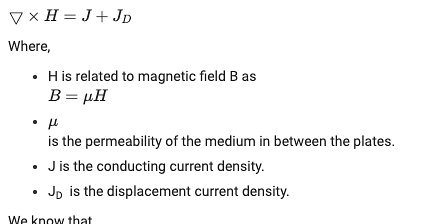
Displacement current is a quantity appearing in Maxwell’s equations. Displacement current definition is defined in terms of the rate of change of the electric displacement field (D). It can be explained by the phenomenon observed in a capacitor.