The expression of magnetic fields associated with four electromagnetic waves are given below :
I. $B_1 = (4 \times 10^{-6} \text{ T}) \sin [0.7 \times 10^3 x + 1.4 \times 10^{11} t]$
II. $B_2 = (2 \times 10^{-7} \text{ T}) \sin [0.6 \times 10^3 x + 1.5 \times 10^{11} t]$
III. $B_3 = (3 \times 10^{-5} \text{ T}) \sin [0.5 \times 10^3 x + 1.5 \times 10^{11} t]$
IV. $B_4 = (5 \times 10^{-4} \text{ T}) \sin [0.2 \times 10^4 x + 4.8 \times 10^{11} t]$
Which wave is travelling in free space ?
I. $B_1 = (4 \times 10^{-6} \text{ T}) \sin [0.7 \times 10^3 x + 1.4 \times 10^{11} t]$
II. $B_2 = (2 \times 10^{-7} \text{ T}) \sin [0.6 \times 10^3 x + 1.5 \times 10^{11} t]$
III. $B_3 = (3 \times 10^{-5} \text{ T}) \sin [0.5 \times 10^3 x + 1.5 \times 10^{11} t]$
IV. $B_4 = (5 \times 10^{-4} \text{ T}) \sin [0.2 \times 10^4 x + 4.8 \times 10^{11} t]$
Which wave is travelling in free space ?
Show Hint
- I
- II
- III
- IV

The Correct Option is C
Solution and Explanation
• The mathematical representation of a propagating electromagnetic wave involves a sinusoidal function typically in the standard form $B = B_0 \sin(kx \pm \omega t)$.
• Here, $k$ definitively represents the angular wave number, and $\omega$ represents the angular frequency.
• The physical propagation speed $v$ of any such wave is robustly determined by the mathematical ratio of its angular frequency to its wave number: $v = \frac{\omega}{k}$.
• For an electromagnetic wave strictly travelling through the vacuum of free space, this calculated speed must exactly equal the universal speed of light, $c \approx 3 \times 10^8 \text{ m/s}$.
Step 1: Extract parameters and calculate speed for Wave I
From the given expression for $B_1$, we identify the coefficients:
Angular wave number, $k_1 = 0.7 \times 10^3 \text{ rad/m}$.
Angular frequency, $\omega_1 = 1.4 \times 10^{11} \text{ rad/s}$.
Calculate the corresponding wave speed $v_1$:
\[ v_1 = \frac{\omega_1}{k_1} = \frac{1.4 \times 10^{11}}{0.7 \times 10^3} \]
\[ v_1 = 2 \times 10^8 \text{ m/s} \]
This speed is significantly less than $c$, meaning it is traveling in a denser medium, not free space.
Step 2: Extract parameters and calculate speed for Wave II
From the given expression for $B_2$:
$k_2 = 0.6 \times 10^3 \text{ rad/m}$.
$\omega_2 = 1.5 \times 10^{11} \text{ rad/s}$.
Calculate the corresponding wave speed $v_2$:
\[ v_2 = \frac{\omega_2}{k_2} = \frac{1.5 \times 10^{11}}{0.6 \times 10^3} \]
\[ v_2 = 2.5 \times 10^8 \text{ m/s} \]
This is also clearly not equal to the definitive speed of light $c$.
Step 3: Extract parameters and calculate speed for Wave III
From the given expression for $B_3$:
$k_3 = 0.5 \times 10^3 \text{ rad/m}$.
$\omega_3 = 1.5 \times 10^{11} \text{ rad/s}$.
Calculate the corresponding wave speed $v_3$:
\[ v_3 = \frac{\omega_3}{k_3} = \frac{1.5 \times 10^{11}}{0.5 \times 10^3} \]
\[ v_3 = 3.0 \times 10^8 \text{ m/s} \]
This meticulously matches the widely accepted speed of light in free space perfectly.
Step 4: Extract parameters and calculate speed for Wave IV for completeness
From the given expression for $B_4$:
$k_4 = 0.2 \times 10^4 \text{ rad/m}$.
$\omega_4 = 4.8 \times 10^{11} \text{ rad/s}$.
Calculate the corresponding wave speed $v_4$:
\[ v_4 = \frac{\omega_4}{k_4} = \frac{4.8 \times 10^{11}}{0.2 \times 10^4} = 24 \times 10^7 = 2.4 \times 10^8 \text{ m/s} \]
This is also incorrect for free space.
Step 5: Conclusion
Only Wave III possesses a calculated propagation velocity that exactly equals $3 \times 10^8 \text{ m/s}$. Therefore, only Wave III is actively travelling in free space. This solidly aligns with option (C).
Top CBSE CLASS XII Physics Questions
- A boy of mass 50 kg is standing at one end of a, boat of length 9 m and mass 400 kg. He runs to the other, end. The distance through which the centre of mass of the boat boy system moves is
- A capillary tube of radius r is dipped inside a large vessel of water. The mass of water raised above water level is M. If the radius of capillary is doubled, the mass of water inside capillary will be
- A circular disc is rotating about its own axis. An external opposing torque 0.02 Nm is applied on the disc by which it comes rest in 5 seconds. The initial angular momentum of disc is
- A circular disc is rotating about its own axis at uniform angular velocity \(\omega.\) The disc is subjected to uniform angular retardation by which its angular velocity is decreased to \(\frac {\omega}{2}\) during 120 rotations. The number of rotations further made by it before coming to rest is
- A constant power is supplied to a rotating disc. The relationship between the angular velocity $\omega$ of the disc and number of rotations (n) made by the disc is governed by
Top CBSE CLASS XII Electromagnetic Waves Questions
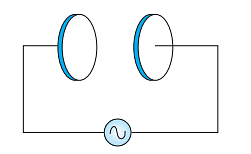
A parallel plate capacitor made of circular plates each of radius R = 6.0 cm has a capacitance C = 100 pF. The capacitor is connected to a 230 V ac supply with a (angular) frequency of 300 rad s−1.
- What is the rms value of the conduction current?
- Is the conduction current equal to the displacement current?
- Determine the amplitude of B at a point 3.0 cm from the axis between the plates.
What physical quantity is the same for X-rays of wavelength \(10^{−10} m\), red light of wavelength \(6800 Å\) and radio waves of wavelength \(500\ m\)?
A plane electromagnetic wave travels in vacuum along z-direction. What can you say about the directions of its electric and magnetic field vectors? If the frequency of the wave is 30 MHz, what is its wavelength?
A radio can tune in to any station in the 7.5 MHz to 12 MHz band. What is the corresponding wavelength band?
A charged particle oscillates about its mean equilibrium position with a frequency of \(10^9 Hz\). What is the frequency of the electromagnetic waves produced by the oscillator?
Top CBSE CLASS XII Questions
- 2, b, c are in A.P. and the range of determinant $\begin{vmatrix}1&1&1\\ 2&b&c\\ 4&b^{2}&c^{2}\end{vmatrix}$ is [2, 16]. Then find range of c is
- A boy of mass 50 kg is standing at one end of a, boat of length 9 m and mass 400 kg. He runs to the other, end. The distance through which the centre of mass of the boat boy system moves is
- A capillary tube of radius r is dipped inside a large vessel of water. The mass of water raised above water level is M. If the radius of capillary is doubled, the mass of water inside capillary will be
- A circular disc is rotating about its own axis. An external opposing torque 0.02 Nm is applied on the disc by which it comes rest in 5 seconds. The initial angular momentum of disc is
- A circular disc is rotating about its own axis at uniform angular velocity \(\omega.\) The disc is subjected to uniform angular retardation by which its angular velocity is decreased to \(\frac {\omega}{2}\) during 120 rotations. The number of rotations further made by it before coming to rest is