Compare the chemistry of the actinoids with that of lanthanoids with reference to:
- electronic configuration
- oxidation states and
- chemical reactivity.
Compare the chemistry of the actinoids with that of lanthanoids with reference to:
- electronic configuration
- oxidation states and
- chemical reactivity.

Solution and Explanation
Electronic configuration
The general electronic configuration for lanthanoids is [Xe]54 4f0-14 5d0-1 6s2 and that for actinoids is [Rn]86 5f1-14 6d0-1 7s2 . Unlike 4f orbitals, 5f orbitals are not deeply buried and participate in bonding to a greater extent.
Oxidation states
The principal oxidation state of lanthanoids is (+3). However, sometimes we also encounter oxidation states of +2 and +4. This is because of extra stability of fully-filled and half-filled orbitals. Actinoids exhibit a greater range of oxidation states. This is because the 5f, 6d, and 7s levels are of comparable energies. Again, (+3) is the principal oxidation state for actinoids. Actinoids such as lanthanoids have more compounds in +3 state than in +4 state.
Chemical reactivity
In the lanthanide series, the earlier members of the series are more reactive. They have reactivity that is comparable to Ca. With an increase in the atomic number, the lanthanides start behaving similar to Al. Actinoids, on the other hand, are highly reactive metals, especially when they are finely divided. When they are added to boiling water, they give a mixture of oxide and hydride. Actinoids combine with most of the non-metals at moderate temperatures. Alkalies have no action on these actinoids. In case of acids, they are slightly affected by nitric acid (because of the formation of a protective oxide layer).
Top CBSE CLASS XII Chemistry Questions
- ${AgNO_3}$ does not decompose where :
- Azeotropic mixture of water and HCl boils at 381.5 K. By distilling the mixture it is possible to obtain
Write IUPAC names of the following compounds and classify them into primary, secondary and tertiary amines.
(i) (CH3 )2CHNH2 (ii) CH3 (CH2 )2NH2 (iii) CH3NHCH(CH3 )2
(iv) (CH3 )3CNH2 (v) C6H5NHCH3 (vi) (CH3CH2 )2NCH3 (vii) m–BrC6H4NH2
Give one chemical test to distinguish between the following pairs of compounds.
(i) Methylamine and dimethylamine
(ii) Secondary and tertiary amines
(iii) Ethylamine and aniline
(iv) Aniline and benzylamine
(v) Aniline and N-methylanilineAccount for the following:
(i) pKb of aniline is more than that of methylamine.
(ii) Ethylamine is soluble in water whereas aniline is not.
(iii) Methylamine in water reacts with ferric chloride to precipitate hydrated ferric oxide.
(iv) Although amino group is o– and p– directing in aromatic electrophilic substitution reactions, aniline on nitration gives a substantial amount of m-nitroaniline.
(v) Aniline does not undergo Friedel-Crafts reaction.
(vi) Diazonium salts of aromatic amines are more stable than those of aliphatic amines. (vii) Gabriel phthalimide synthesis is preferred for synthesising primary amines.
Top CBSE CLASS XII d -and f -Block Elements Questions
Write down the electronic configuration of:
(i) Cr3+ (iii) Cu+ (v) Co2+ (vii) Mn2+
(ii) Pm3+ (iv) Ce4+ (vi) Lu2+ (viii) Th4+Why are Mn2+ compounds more stable than Fe2+ towards oxidation to their +3 state?
- Explain briefly how +2 state becomes more and more stable in the first half of the first row transition elements with increasing atomic number?
- To what extent do the electronic configurations decide the stability of oxidation states in the first series of the transition elements? Illustrate your answer with examples.
What may be the stable oxidation state of the transition element with the following d electron configurations in the ground state of their atoms : 3d3 ,3d5 ,3d8 and 3d4?
Top CBSE CLASS XII Questions
- 2, b, c are in A.P. and the range of determinant $\begin{vmatrix}1&1&1\\ 2&b&c\\ 4&b^{2}&c^{2}\end{vmatrix}$ is [2, 16]. Then find range of c is
- A boy of mass 50 kg is standing at one end of a, boat of length 9 m and mass 400 kg. He runs to the other, end. The distance through which the centre of mass of the boat boy system moves is
- A capillary tube of radius r is dipped inside a large vessel of water. The mass of water raised above water level is M. If the radius of capillary is doubled, the mass of water inside capillary will be
- A circular disc is rotating about its own axis. An external opposing torque 0.02 Nm is applied on the disc by which it comes rest in 5 seconds. The initial angular momentum of disc is
- A circular disc is rotating about its own axis at uniform angular velocity \(\omega.\) The disc is subjected to uniform angular retardation by which its angular velocity is decreased to \(\frac {\omega}{2}\) during 120 rotations. The number of rotations further made by it before coming to rest is
Concepts Used:
Lanthanoids
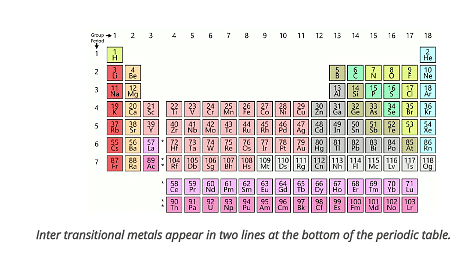
Lanthanoids are at the top of these two-row, while actinoids are at the bottom row.
Properties of Lanthanoids
Lanthanoids are inclusive of 14 elements, with atomic numbers 58-71:
- Cerium - Xe 4f1 5d1 6s2
- Praseodymium - Xe 4f3 6s2
- Neodymium - Xe 4f4 6s2
- Promethium - Xe 4f5 6s2
- Samarium - Xe 4f6 6s2
- Europium - Xe 4f7 6s2
- Gadolinium - Xe 4f7 5d1 6s2
- Terbium - Xe 4f9 6s2
- Dysprosium - Xe 4f10 6s2
- Holmium - Xe 4f11 6s2
- Erbium - Xe 4f12 6s2
- Thulium - Xe 4f13 6s2
- Ytterbium - Xe 4f14 6s2
- Lutetium - Xe 4f14 5d1 6s2
These elements are also called rare earth elements. They are found naturally on the earth, and they're all radioactively stable except promethium, which is radioactive. A trend is one of the interesting properties of the lanthanoid elements, called lanthanide contraction.