An electromagnetic wave is travelling in vertically upward direction. At an instant, its electric field vector points in west direction. In which direction does the magnetic field vector point at that instant?
Show Hint

Solution and Explanation
We are given an electromagnetic wave traveling in the vertically upward direction, and at a certain instant, its electric field vector points in the west direction. We are tasked with determining the direction of the magnetic field vector at that instant.
1. Understanding the Relationship Between Electric and Magnetic Fields in an Electromagnetic Wave:
In an electromagnetic wave, the electric field (\( \vec{E} \)) and magnetic field (\( \vec{B} \)) are always perpendicular to each other and also perpendicular to the direction of propagation of the wave. This means the three vectors—electric field, magnetic field, and the direction of wave propagation—form a right-handed coordinate system.
2. Direction of Propagation and Fields:
Let's define the directions using a coordinate system:
- The wave is traveling in the vertically upward direction, which corresponds to the \( +y \)-axis in a typical 3D coordinate system.
- The electric field vector (\( \vec{E} \)) points in the west direction, which corresponds to the \( -x \)-axis (since west is usually defined as negative \( x \)-direction in a standard geographic coordinate system).
- According to the right-hand rule, the magnetic field (\( \vec{B} \)) must be perpendicular to both the electric field vector (\( \vec{E} \)) and the direction of propagation of the wave (the \( y \)-axis).
3. Applying the Right-Hand Rule:
To find the direction of the magnetic field vector (\( \vec{B} \)), we use the right-hand rule, which states that if the thumb of your right hand points in the direction of wave propagation (upward, or \( +y \)-axis), and the index finger points in the direction of the electric field (\( -x \)-axis, or west), then the middle finger will point in the direction of the magnetic field.
Using the right-hand rule, with the electric field pointing west (along \( -x \)) and the wave propagating vertically upward (along \( +y \)), the magnetic field vector will point in the north direction, or along the \( +z \)-axis.
4. Conclusion:
At the instant when the electric field vector points in the west direction, the magnetic field vector points in the north direction.
Top CBSE CLASS XII Physics Questions
- A boy of mass 50 kg is standing at one end of a, boat of length 9 m and mass 400 kg. He runs to the other, end. The distance through which the centre of mass of the boat boy system moves is
- A capillary tube of radius r is dipped inside a large vessel of water. The mass of water raised above water level is M. If the radius of capillary is doubled, the mass of water inside capillary will be
- A circular disc is rotating about its own axis. An external opposing torque 0.02 Nm is applied on the disc by which it comes rest in 5 seconds. The initial angular momentum of disc is
- A circular disc is rotating about its own axis at uniform angular velocity \(\omega.\) The disc is subjected to uniform angular retardation by which its angular velocity is decreased to \(\frac {\omega}{2}\) during 120 rotations. The number of rotations further made by it before coming to rest is
- A constant power is supplied to a rotating disc. The relationship between the angular velocity $\omega$ of the disc and number of rotations (n) made by the disc is governed by
Top CBSE CLASS XII Electromagnetic Waves Questions
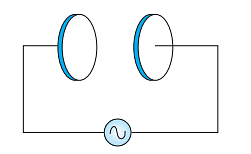
A parallel plate capacitor made of circular plates each of radius R = 6.0 cm has a capacitance C = 100 pF. The capacitor is connected to a 230 V ac supply with a (angular) frequency of 300 rad s−1.
- What is the rms value of the conduction current?
- Is the conduction current equal to the displacement current?
- Determine the amplitude of B at a point 3.0 cm from the axis between the plates.
What physical quantity is the same for X-rays of wavelength \(10^{−10} m\), red light of wavelength \(6800 Å\) and radio waves of wavelength \(500\ m\)?
A plane electromagnetic wave travels in vacuum along z-direction. What can you say about the directions of its electric and magnetic field vectors? If the frequency of the wave is 30 MHz, what is its wavelength?
A radio can tune in to any station in the 7.5 MHz to 12 MHz band. What is the corresponding wavelength band?
A charged particle oscillates about its mean equilibrium position with a frequency of \(10^9 Hz\). What is the frequency of the electromagnetic waves produced by the oscillator?
Top CBSE CLASS XII Questions
- 2, b, c are in A.P. and the range of determinant $\begin{vmatrix}1&1&1\\ 2&b&c\\ 4&b^{2}&c^{2}\end{vmatrix}$ is [2, 16]. Then find range of c is
- A boy of mass 50 kg is standing at one end of a, boat of length 9 m and mass 400 kg. He runs to the other, end. The distance through which the centre of mass of the boat boy system moves is
- A capillary tube of radius r is dipped inside a large vessel of water. The mass of water raised above water level is M. If the radius of capillary is doubled, the mass of water inside capillary will be
- A circular disc is rotating about its own axis. An external opposing torque 0.02 Nm is applied on the disc by which it comes rest in 5 seconds. The initial angular momentum of disc is
- A circular disc is rotating about its own axis at uniform angular velocity \(\omega.\) The disc is subjected to uniform angular retardation by which its angular velocity is decreased to \(\frac {\omega}{2}\) during 120 rotations. The number of rotations further made by it before coming to rest is