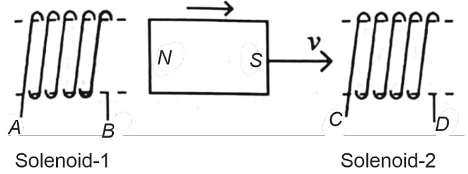
In the above diagram, a strong bar magnet is moving towards solenoid-2 from solenoid-1. The direction of induced current in solenoid-1 and that in solenoid-2, respectively, are through the directions :
A particle is moving along x-axis with its position ($ x $) varying with time ($ t $) as: $ x = \alpha t^4 + \beta t^2 + \gamma t + \delta. $ The ratio of its initial velocity to its initial acceleration, respectively, is:
The following graph represents the T-V curves of an ideal gas ( where T is the temperature and V the volume) at three pressures P1, P2 and P3 compared with those of Charles's law represented as dotted lines.
Then the correct relation is :
A wire of length and resistance \(100\) is divided into 10 equal parts. The first \(5\) parts are connected in series while the next \(5\) parts are connected in parallel. The two combinations are again connected in series. The resistance of this final combination is:
List I
List II