Two straight conducting plates form an angle θ where their ends are joined. A conducting bar in contact with the plates and forming an isosceles triangle with them, starts at the vertex at time t = 0 and moves with constant velocity v to the right as shown in the figure. A magnetic field B points out of the page. The magnitude of emf induced at t = 1 second will be:

Show Hint
- \( Bv \tan \frac{\theta}{2} \)
- \( 2Bv^2 \tan \frac{\theta}{2} \)
- \( 2Bv^2 \cot \frac{\theta}{2} \)
- \( 2Bv^2 \sin \frac{\theta}{2} \)

The Correct Option is B
Solution and Explanation
The motion of the conducting bar creates a change in the area enclosed by the conducting plates, which results in an induced emf. The emf (\(\mathcal{E}\)) is given by Faraday’s law of electromagnetic induction: \[ \mathcal{E} = \frac{d\Phi}{dt}, \] where \(\Phi\) is the magnetic flux. The magnetic flux is: \[ \Phi = B \cdot \text{Area}. \] At \(t = 1\) second, the distance moved by the bar is: \[ x = vt, \] where \(v\) is the velocity of the bar and \(t = 1\). Step 1: Area of the Triangle Formed The height of the triangle at time \(t\) is: \[ h = x \tan \frac{\theta}{2} = vt \tan \frac{\theta}{2}. \] The area of the triangle is: \[ \text{Area} = \frac{1}{2} \cdot \text{Base} \cdot \text{Height}. \] The base of the triangle is \(2x\), so: \[ \text{Area} = \frac{1}{2} \cdot 2x \cdot h = x^2 \tan \frac{\theta}{2}. \] Step 2: Magnetic Flux The magnetic flux through the triangle is: \[ \Phi = B \cdot \text{Area} = B \cdot x^2 \tan \frac{\theta}{2}. \] Step 3: Induced emf The induced emf is the rate of change of flux: \[ \mathcal{E} = \frac{d\Phi}{dt} = \frac{d}{dt} \left( B \cdot x^2 \tan \frac{\theta}{2} \right). \] Since \(\tan \frac{\theta}{2}\) and \(B\) are constants, we differentiate \(x^2\) with respect to \(t\): \[ \mathcal{E} = B \cdot \tan \frac{\theta}{2} \cdot \frac{d(x^2)}{dt}. \] \[ \frac{d(x^2)}{dt} = 2x \cdot \frac{dx}{dt} = 2xv. \] Substitute \(x = vt\) and \(t = 1\): \[ \mathcal{E} = B \cdot \tan \frac{\theta}{2} \cdot 2(vt)v. \] At \(t = 1\): \[ \mathcal{E} = 2Bv^2 \tan \frac{\theta}{2}. \] Conclusion The induced emf at \(t = 1\) second is: \[ \boxed{2Bv^2 \tan \frac{\theta}{2}}. \]
Top WBJEE Physics Questions
- The velocity of a particle executing a simple harmonic motion is $13\, ms^{-1}$, when its distance from the equilibrium position (Q) is 3 m and its velocity is $12 \, ms^{-1}$, when it is 5 m away from The frequency of the simple harmonic motion is
- A and B are two parallel sided transparent slabs of refractive indices n$_1 $and n$_2$ respectively. A ray is incident at an angle $\theta$ on the surface of separation of A and B, and after refraction from B into air grazes the surface of B. Then
- The minimum and maximum capacitances, which may be obtained by the combination of three capacitors each of capacitance 6$\mu$ F are
- The increase in electrostatic potential energy of a dipole of moment p when it is taken from parallel to anti-parallel orientation in an electric field E is
- A zener diode has break down voltage of 5.0 V. The resistance required to allow a current of 100 mA through the zener in reverse bias when connected to a battery of emf 12 V is
Top WBJEE Electromagnetic induction Questions
- The magnetic flux linked with a coil satisfies the relation $\phi= (4t^2 + 6t + 9) Wb$, where $t$ is the time in second. The e.m.f. induced in the coil at $t\, =\, 2$ second is
- Which of the following materials is the best conductor of electricity?
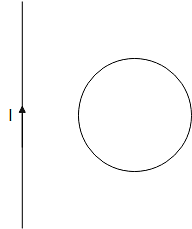
- A circular coil is placed near a current-carrying conductor, both lying on the plane of the paper. The current is flowing through the conductor in such a way that the induced current in the loop is clockwise as shown in the figure. The current in the wire
- An amount of charge Q passes through a coil of resistance R.If the current in the coil decreases to zero at a uniform rate during time T, then the amount of heat generated in the coil will be,
- In a closed circuit there is only a coil of inductance $L$ and resistance $100\ \Omega$. The coil is situated in a uniform magnetic field. All of a sudden, the magnetic flux linked with the circuit changes by $5$ Weber. What amount of charge will flow in the circuit as a result?
Top WBJEE Questions
- Let $\vec{\alpha } = \hat{i} + \hat{j} + \hat{k} , \vec{\beta} = \hat{i} - \hat{j} - \hat{k}$ and $\vec{\gamma} = - \hat{i} + \hat{j} - \hat{k}$ be three vectors. A vector $\vec{\delta} $, in the plane of $\vec{\alpha}$ and $\vec{\beta}$, whose projection on $\vec{\gamma}$ is $\frac{1}{\sqrt{3}}$, is given by
- Let a, b, c be real numbers such that $a + b + c < 0$ and the quadratic equation $ax^2 + bx + c = 0$ has imaginary roots. Then
- If the radius of a spherical balloon increases by 0.1%, then its volume increases approximately by
- The velocity of a particle executing a simple harmonic motion is $13\, ms^{-1}$, when its distance from the equilibrium position (Q) is 3 m and its velocity is $12 \, ms^{-1}$, when it is 5 m away from The frequency of the simple harmonic motion is
- By which of the following methods, new and better varieties of plants can be formed?