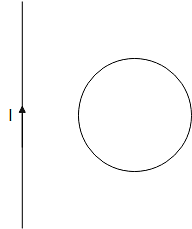
A circular coil is placed near a current-carrying conductor, both lying on the plane of the paper. The current is flowing through the conductor in such a way that the induced current in the loop is clockwise as shown in the figure. The current in the wire
- time-dependent and downward
- steady and upward
- time-dependent and upward
- An alternating current

The Correct Option is A
Approach Solution - 1
To analyze the given problem, we use Faraday's Law of Induction and Lenz's Law. The setup involves a circular coil placed near a current-carrying conductor, both lying on the plane of the paper. The induced current in the loop is clockwise.
Analyzing the Induced Current
- Direction of the Induced Current:
The induced current is clockwise. By Lenz's Law, it must oppose the change in magnetic flux. - Change in Magnetic Flux:
A clockwise induced current means the magnetic flux through the loop is increasing out of the plane. To oppose this, the induced magnetic field is into the plane. - Current in the Wire:
For the magnetic flux to be increasing out of the plane, the magnetic field at the loop’s location must be increasing and directed out of the plane. According to the right-hand rule, this happens if the current in the wire is downward. - Time Dependence:
Since the flux is changing, the current in the wire must be increasing with time — i.e., time-dependent.
Conclusion
The current in the wire is time-dependent and downward.
Final Answer: (A): time-dependent and downward
Approach Solution -2
In this scenario, the loop is positioned to the right of the current-carrying wire, even though it might seem as if it's on the left side. This is because, when you move in the direction of the current, the loop is situated to the right.
Now, as the current diminishes, the induced current within the loop is in a clockwise direction (S), as illustrated in the diagram.
Correct Option: (A): time-dependent and downward
Top WBJEE Physics Questions
- The velocity of a particle executing a simple harmonic motion is $13\, ms^{-1}$, when its distance from the equilibrium position (Q) is 3 m and its velocity is $12 \, ms^{-1}$, when it is 5 m away from The frequency of the simple harmonic motion is
- A and B are two parallel sided transparent slabs of refractive indices n$_1 $and n$_2$ respectively. A ray is incident at an angle $\theta$ on the surface of separation of A and B, and after refraction from B into air grazes the surface of B. Then
- The minimum and maximum capacitances, which may be obtained by the combination of three capacitors each of capacitance 6$\mu$ F are
- The increase in electrostatic potential energy of a dipole of moment p when it is taken from parallel to anti-parallel orientation in an electric field E is
- A zener diode has break down voltage of 5.0 V. The resistance required to allow a current of 100 mA through the zener in reverse bias when connected to a battery of emf 12 V is
Top WBJEE Electromagnetic induction Questions
- The magnetic flux linked with a coil satisfies the relation $\phi= (4t^2 + 6t + 9) Wb$, where $t$ is the time in second. The e.m.f. induced in the coil at $t\, =\, 2$ second is
- Which of the following materials is the best conductor of electricity?
- An amount of charge Q passes through a coil of resistance R.If the current in the coil decreases to zero at a uniform rate during time T, then the amount of heat generated in the coil will be,
- In a closed circuit there is only a coil of inductance $L$ and resistance $100\ \Omega$. The coil is situated in a uniform magnetic field. All of a sudden, the magnetic flux linked with the circuit changes by $5$ Weber. What amount of charge will flow in the circuit as a result?
- As shown in the figure, a rectangular loop of length $a$ and width $b$ and made of a conducting material of uniform cross-section is kept in a horizontal plane where a uniform magnetic field of intensity $B$ is acting vertically downward. The resistance per unit length of the loop is $\lambda \, \Omega / m$. If the loop is pulled with uniform velocity $v$ in a horizontal direction, which of the following statement(s) is/are true?

Top WBJEE Questions
- Let $\vec{\alpha } = \hat{i} + \hat{j} + \hat{k} , \vec{\beta} = \hat{i} - \hat{j} - \hat{k}$ and $\vec{\gamma} = - \hat{i} + \hat{j} - \hat{k}$ be three vectors. A vector $\vec{\delta} $, in the plane of $\vec{\alpha}$ and $\vec{\beta}$, whose projection on $\vec{\gamma}$ is $\frac{1}{\sqrt{3}}$, is given by
- Let a, b, c be real numbers such that $a + b + c < 0$ and the quadratic equation $ax^2 + bx + c = 0$ has imaginary roots. Then
- If the radius of a spherical balloon increases by 0.1%, then its volume increases approximately by
- The velocity of a particle executing a simple harmonic motion is $13\, ms^{-1}$, when its distance from the equilibrium position (Q) is 3 m and its velocity is $12 \, ms^{-1}$, when it is 5 m away from The frequency of the simple harmonic motion is
- By which of the following methods, new and better varieties of plants can be formed?
Concepts Used:
Electromagnetic Induction
Electromagnetic Induction is a current produced by the voltage production due to a changing magnetic field. This happens in one of the two conditions:-
- When we place the conductor in a changing magnetic field.
- When the conductor constantly moves in a stationary field.
Formula:
The electromagnetic induction is mathematically represented as:-
e=N × d∅.dt
Where
- e = induced voltage
- N = number of turns in the coil
- Φ = Magnetic flux (This is the amount of magnetic field present on the surface)
- t = time
Applications of Electromagnetic Induction
- Electromagnetic induction in AC generator
- Electrical Transformers
- Magnetic Flow Meter