Question:
The value of $\displaystyle\lim_{n \to \infty} \frac{1}{n} \left\{ \sec^2 \frac{\pi}{4 n} + \sec^2 \frac{2 \pi }{4n} + ..... \sec^2 \frac{n \pi}{4n} \right\}$ is
The value of $\displaystyle\lim_{n \to \infty} \frac{1}{n} \left\{ \sec^2 \frac{\pi}{4 n} + \sec^2 \frac{2 \pi }{4n} + ..... \sec^2 \frac{n \pi}{4n} \right\}$ is
Updated On: Apr 26, 2024
- $\log_e \, 2 $
- $\frac{\pi}{2}$
- $\frac{4}{\pi}$
- $e$
Show Solution

Verified By Collegedunia
The Correct Option is C
Solution and Explanation
We have, $\displaystyle\lim _{n \rightarrow \infty} \frac{1}{n}\left\{\sec ^{2} \frac{\pi}{4 n}+\sec ^{2} \frac{2 \pi}{4 n}+\ldots+\sec ^{2} \frac{n \pi}{4 n}\right\}$
$=\displaystyle\lim _{n \rightarrow \infty} \displaystyle\sum_{r=1}^{n} \frac{1}{n} \sec ^{2}\left(\frac{r \pi}{4 n}\right)=\int\limits_{0}^{1} \sec ^{2}\left(\frac{\pi x}{4}\right)$
$=\frac{4}{\pi}\left[\tan \left(\frac{\pi x}{4}\right)\right]_{0}^{1}$
$=\frac{4}{\pi} \times 1=\frac{4}{\pi}$
$=\displaystyle\lim _{n \rightarrow \infty} \displaystyle\sum_{r=1}^{n} \frac{1}{n} \sec ^{2}\left(\frac{r \pi}{4 n}\right)=\int\limits_{0}^{1} \sec ^{2}\left(\frac{\pi x}{4}\right)$
$=\frac{4}{\pi}\left[\tan \left(\frac{\pi x}{4}\right)\right]_{0}^{1}$
$=\frac{4}{\pi} \times 1=\frac{4}{\pi}$
Was this answer helpful?
0
0
Top WBJEE Mathematics Questions
- Let $\vec{\alpha } = \hat{i} + \hat{j} + \hat{k} , \vec{\beta} = \hat{i} - \hat{j} - \hat{k}$ and $\vec{\gamma} = - \hat{i} + \hat{j} - \hat{k}$ be three vectors. A vector $\vec{\delta} $, in the plane of $\vec{\alpha}$ and $\vec{\beta}$, whose projection on $\vec{\gamma}$ is $\frac{1}{\sqrt{3}}$, is given by
- Let a, b, c be real numbers such that $a + b + c < 0$ and the quadratic equation $ax^2 + bx + c = 0$ has imaginary roots. Then
- If the radius of a spherical balloon increases by 0.1%, then its volume increases approximately by
- If $\theta + \phi = \frac{\pi}{4}$, then $\left(1+ \tan\,?\right)\left(1+ \tan\,\phi\right)$ is equal to
- $\frac {3x^2+1}{x^2-6x+8}$ is equal to
View More Questions
Top WBJEE limits of trigonometric functions Questions
Top WBJEE Questions
- Let $\vec{\alpha } = \hat{i} + \hat{j} + \hat{k} , \vec{\beta} = \hat{i} - \hat{j} - \hat{k}$ and $\vec{\gamma} = - \hat{i} + \hat{j} - \hat{k}$ be three vectors. A vector $\vec{\delta} $, in the plane of $\vec{\alpha}$ and $\vec{\beta}$, whose projection on $\vec{\gamma}$ is $\frac{1}{\sqrt{3}}$, is given by
- Let a, b, c be real numbers such that $a + b + c < 0$ and the quadratic equation $ax^2 + bx + c = 0$ has imaginary roots. Then
- If the radius of a spherical balloon increases by 0.1%, then its volume increases approximately by
- The velocity of a particle executing a simple harmonic motion is $13\, ms^{-1}$, when its distance from the equilibrium position (Q) is 3 m and its velocity is $12 \, ms^{-1}$, when it is 5 m away from The frequency of the simple harmonic motion is
- By which of the following methods, new and better varieties of plants can be formed?
View More Questions
Concepts Used:
Limits of Trigonometric Functions
Assume a is any number in the general domain of the corresponding trigonometric function, then we can explain the following limits.
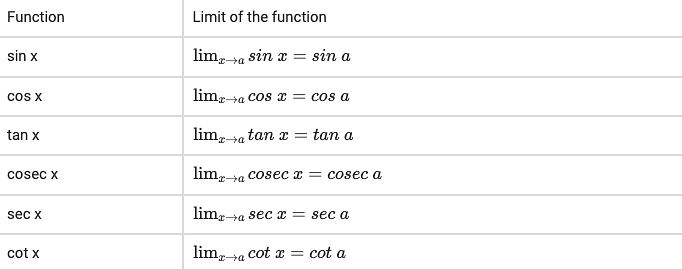
We know that the graphs of the functions y = sin x and y = cos x detain distinct values between -1 and 1 as represented in the above figure. Thus, the function is swinging between the values, so it will be impossible for us to obtain the limit of y = sin x and y = cos x as x tends to ±∞. Hence, the limits of all six trigonometric functions when x tends to ±∞ are tabulated below:
