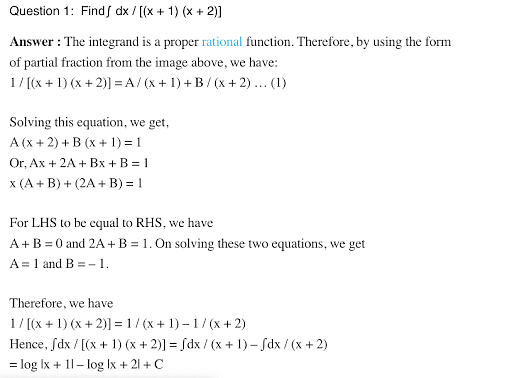
Integrate the function: \(tan^{-1}x\)

Solution and Explanation
The correct answer is: \(xtan^{-1}x-\frac{1}{2}log(1+x^2)+C\)
Let \(I=∫1.tan^{-1}x dx\)
Taking \(tan^{-1}x\) as first function and 1 as second function and integrating by parts,we
obtain
\(I=tan^{-1}x∫1dx-∫[{(\frac{d}{dx}tan^{-1}x)∫1.dx}]dx\)
\(=tan^{-1}x.x-∫\frac{1}{1+x^2}.x dx\)
\(=xtan^{-1}x-\frac{1}{2}∫\frac{2x}{1+x^2} dx\)
\(=xtan^{-1}x-\frac{1}{2}log|1+x^2|+C\)
\(=xtan^{-1}x-\frac{1}{2}log(1+x^2)+C\)
Top CBSE CLASS XII Mathematics Questions
- 2, b, c are in A.P. and the range of determinant $\begin{vmatrix}1&1&1\\ 2&b&c\\ 4&b^{2}&c^{2}\end{vmatrix}$ is [2, 16]. Then find range of c is
- A committee of 11 members is to be formed from 8 males and 5 females. Let m denotes the number of ways of selecting committee having atleast 6 males and n denotes the number of ways of selecting atleast 3 females then
Determine whether each of the following relations are reflexive, symmetric, and transitive.
- Relation R in the set A={1,2,3,...13,14} defined as R={(x,y): 3x-y=0}.
- Relation R in the set of N natural numbers defined as R={(x,y): y=x+5 and x<4}.
- Relation R in the set A={1,2,3,4,5,6} defined as R={(x,y): y is divisible by x}.
- Relation R in the set of Z integers defined as R={(x,y): x-y is an integer}
- Relation R in the set of human beings in a town at a particular time given by
- R={(x,y): x and y work at same place}
- R={(x,y): x and y live in the same locality}
- R={(x,y): x is exactly 7 am taller that y}
- R={(x,y): x is wife of y}
- R={(x,y):x is father of y}
Show that the relation R in the set R of real numbers, defined as
R = {(a, b): a ≤ b2 } is neither reflexive nor symmetric nor transitive.Check whether the relation R defined in the set {1, 2, 3, 4, 5, 6} as
R = {(a, b): b = a + 1} is reflexive, symmetric or transitive.
Top CBSE CLASS XII integral Questions
- Evaluate the integral: \(\int_{0}^{2}\frac{dx}{x+4-x^2}\)
Find the area of the region bounded by the curve y2=x and the lines x=1,x=4 and the x-axis
Find the area of the region bounded by y2=9x, x=2, x=4 and the x-axis in the first quadrant.
Find the area of the region bounded by x2=4y,y=2,y=4 and the x-axis in the first quadrant.
Find the area of the region bounded by the ellipse \(\frac{x^2}{16}+\frac{y^2}{9}=1\)
Top CBSE CLASS XII Questions
- 2, b, c are in A.P. and the range of determinant $\begin{vmatrix}1&1&1\\ 2&b&c\\ 4&b^{2}&c^{2}\end{vmatrix}$ is [2, 16]. Then find range of c is
- A boy of mass 50 kg is standing at one end of a, boat of length 9 m and mass 400 kg. He runs to the other, end. The distance through which the centre of mass of the boat boy system moves is
- A capillary tube of radius r is dipped inside a large vessel of water. The mass of water raised above water level is M. If the radius of capillary is doubled, the mass of water inside capillary will be
- A circular disc is rotating about its own axis. An external opposing torque 0.02 Nm is applied on the disc by which it comes rest in 5 seconds. The initial angular momentum of disc is
- A circular disc is rotating about its own axis at uniform angular velocity \(\omega.\) The disc is subjected to uniform angular retardation by which its angular velocity is decreased to \(\frac {\omega}{2}\) during 120 rotations. The number of rotations further made by it before coming to rest is
Concepts Used:
Integration by Partial Fractions
The number of formulas used to decompose the given improper rational functions is given below. By using the given expressions, we can quickly write the integrand as a sum of proper rational functions.
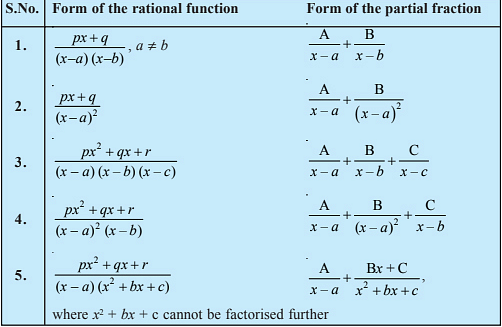
For examples,