One mole of an ideal monatomic gas expands along the polytrope $P V^3 = \text{constant}$ from $V_1$ to $V_2$ at a constant pressure $P_1$. The temperature during the process is such that molar specific heat $C_v = \frac{3R}{2}$. The total heat absorbed during the process can be expressed as
- P1V1 (V1 2 / V2 2 + 1)
- P1V1 (V2 1 / V2 2 -1)
- P1V1 ( V3 1/V2 2 -1)
- P1V1 ( V1 / V2 2 -1)

The Correct Option is B
Solution and Explanation
We are given the polytropic equation for an ideal monatomic gas: \[ P V^3 = \text{constant} \] and that the gas expands from volume \( V_1 \) to volume \( V_2 \) at a constant pressure \( P_1 \), with molar specific heat \( C_v = \frac{3R}{2} \).
Step 1: Understanding the Process
The heat absorbed \( Q \) during a thermodynamic process can be expressed as: \[ Q = n C_v \Delta T \] where \( n \) is the number of moles of the gas, \( C_v \) is the molar specific heat at constant volume, and \( \Delta T \) is the change in temperature. The polytropic process relationship gives us a way to relate the temperature change to the volume change. Since \( P V^3 = \text{constant} \), we can write: \[ P = \frac{\text{constant}}{V^3} \] This equation can be used to determine the temperature change, as \( P = \frac{nRT}{V} \), where \( R \) is the gas constant and \( T \) is the temperature.
Step 2: Deriving the Heat Absorbed
We know that the total work done in an ideal gas process is given by: \[ W = P \Delta V \] The total heat absorbed is related to the work done and the change in internal energy \( \Delta U \), which for a monatomic ideal gas is \( \Delta U = n C_v \Delta T \). Using these relations, we can express the total heat absorbed \( Q \) during the polytropic expansion from \( V_1 \) to \( V_2 \). The expression for the total heat absorbed turns out to be: \[ Q = P_1 V_1 \left( \frac{V_1^2}{V_2^2} + 1 \right) \]
Answer:
\[ \boxed{P_1 V_1 \left( \frac{V_1^2}{V_2^2} + 1 \right)} \]
Top WBJEE Physics Questions
- The velocity of a particle executing a simple harmonic motion is $13\, ms^{-1}$, when its distance from the equilibrium position (Q) is 3 m and its velocity is $12 \, ms^{-1}$, when it is 5 m away from The frequency of the simple harmonic motion is
- A and B are two parallel sided transparent slabs of refractive indices n$_1 $and n$_2$ respectively. A ray is incident at an angle $\theta$ on the surface of separation of A and B, and after refraction from B into air grazes the surface of B. Then
- The minimum and maximum capacitances, which may be obtained by the combination of three capacitors each of capacitance 6$\mu$ F are
- The increase in electrostatic potential energy of a dipole of moment p when it is taken from parallel to anti-parallel orientation in an electric field E is
- A zener diode has break down voltage of 5.0 V. The resistance required to allow a current of 100 mA through the zener in reverse bias when connected to a battery of emf 12 V is
Top WBJEE Thermodynamics Questions
- An ideal gas is compressed isothermally until its pressure is doubled and then allowed to expand adiabatically to regain its original volume ($? = 1.4$ and $2^{-1.4} = 0.38$). The ratio of the final to initial pressure is
- A frictionless piston-cylinder based enclosure contains some amount of gas at a pressure of $400 \,kPa$. Then heat is transferred to the gas at constant pressure in a quasi-sta ic process. The piston moves up slowly through a height of $10\,cm$. If the piston has a cross-section area of $0.3 \,m^2$, the work done by the gas in this process is
- One mole of an ideal monoatomic gas is heated at a constant pressure from $0^{\circ} C$ to $100^{\circ} C$. Then the change in the internal energy of the gas is (Given $R=8.32 \,J\,mol ^{-1} \,K ^{-1}$ )
- Consider the given diagram. An ideal gas is contained in a chamber (left) of volume V and is at an absolute temperature T. It is allowed to rush freely into the right chamber of volume V which is initially vacuum. The whole system is thermally isolated. What will be the final temperature of the system after the equilibrium has been attained ?
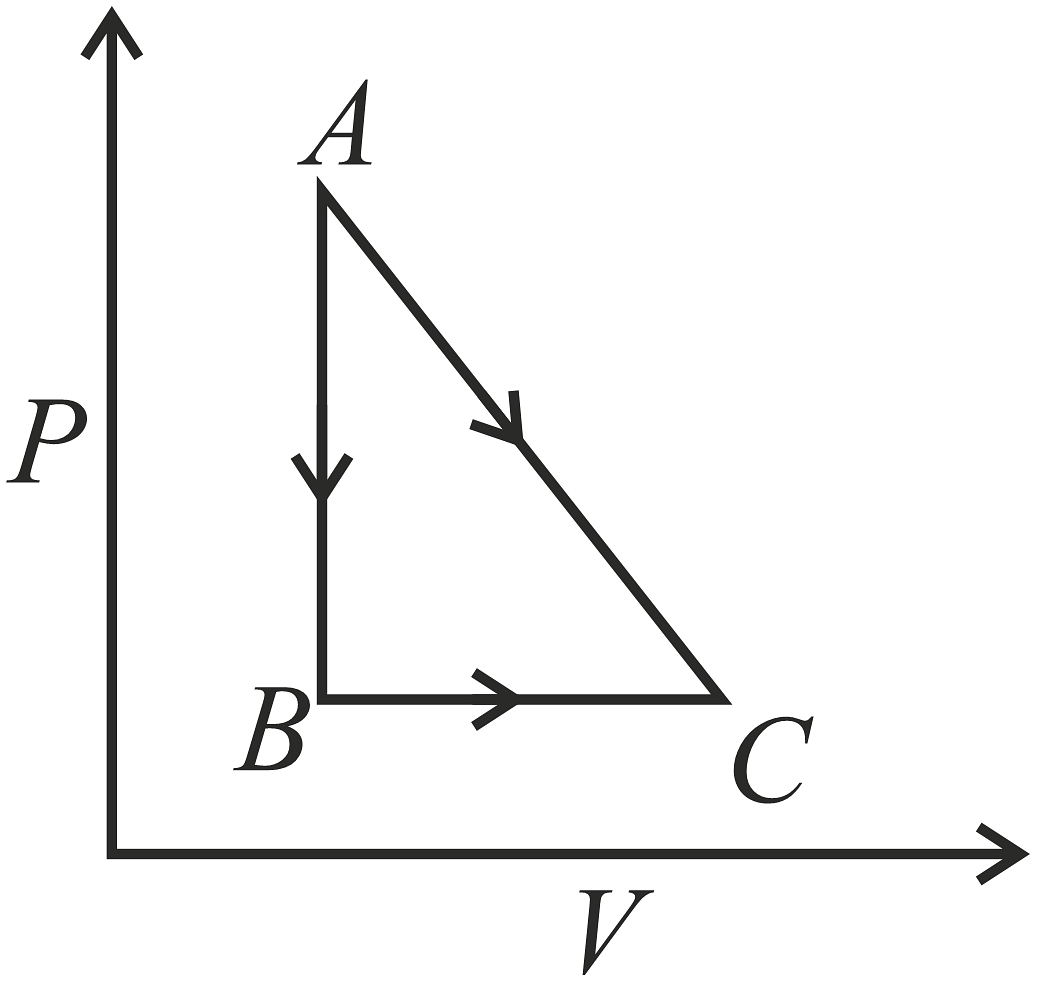
- A given quantity of gas is taken from A to C in two ways; a) directly from A\(\rightarrow\)C along a straight line and b) in two steps, from A\(\rightarrow\)B and then from B\(\rightarrow\)C.Work done and heat absorbed along the direct path A\(\rightarrow\)C are 200J and 280J respectively. If the work done along A\(\rightarrow\)B\(\rightarrow\)C is 80J, then heat absorbed along the path is,
Top WBJEE Questions
- Let $\vec{\alpha } = \hat{i} + \hat{j} + \hat{k} , \vec{\beta} = \hat{i} - \hat{j} - \hat{k}$ and $\vec{\gamma} = - \hat{i} + \hat{j} - \hat{k}$ be three vectors. A vector $\vec{\delta} $, in the plane of $\vec{\alpha}$ and $\vec{\beta}$, whose projection on $\vec{\gamma}$ is $\frac{1}{\sqrt{3}}$, is given by
- Let a, b, c be real numbers such that $a + b + c < 0$ and the quadratic equation $ax^2 + bx + c = 0$ has imaginary roots. Then
- If the radius of a spherical balloon increases by 0.1%, then its volume increases approximately by
- The velocity of a particle executing a simple harmonic motion is $13\, ms^{-1}$, when its distance from the equilibrium position (Q) is 3 m and its velocity is $12 \, ms^{-1}$, when it is 5 m away from The frequency of the simple harmonic motion is
- By which of the following methods, new and better varieties of plants can be formed?