Match the pair of drugs and their family:
Column A (Drugs):
1. Snake root
2. Artemisia
3. Bitter almond
4. Myrrh
Column B (Family):
(P) Compositae
(Q) Rosaceae
(R) Apocynaceae
(S) Burseraceae
Column A (Drugs):
1. Snake root
2. Artemisia
3. Bitter almond
4. Myrrh
Column B (Family):
(P) Compositae
(Q) Rosaceae
(R) Apocynaceae
(S) Burseraceae
Show Hint
- $ \text{1-[R], 2-[P], 3-[Q], 4-[S]} $
- $ \text{1-[Q], 2-[R], 3-[P], 4-[S]} $
- $ \text{1-[P], 2-[Q], 3-[S], 4-[R]} $
- $ \text{1-[S], 2-[P], 3-[R], 4-[Q]} $

The Correct Option is A
Approach Solution - 1
- 1. Snake root $\rightarrow$ Rauwolfia serpentina, belongs to Apocynaceae family.
$ \Rightarrow $ [R]
- 2. Artemisia $\rightarrow$ Source of drugs like artemisinin, belongs to Compositae (Asteraceae) family.
$ \Rightarrow $ [P]
- 3. Bitter almond $\rightarrow$ From Prunus amygdalus, belongs to Rosaceae family.
$ \Rightarrow $ [Q]
- 4. Myrrh $\rightarrow$ Oleo-gum resin from Commiphora species, belongs to Burseraceae family.
$ \Rightarrow $ [S]
Approach Solution -2
This question checks whether each crude drug is correctly linked to its parent plant family: snake root, artemisia, bitter almond and myrrh against Apocynaceae, Compositae, Rosaceae and Burseraceae. Instead of matching drug by drug, each full combination given in the options can be tested against three fixed facts: snake root (Rauwolfia serpentina) belongs to Apocynaceae, artemisia belongs to Compositae, and myrrh (from Commiphora) belongs to Burseraceae.
- 1-[R], 2-[P], 3-[Q], 4-[S]: Snake root is placed in Apocynaceae (R), artemisia in Compositae (P), bitter almond in Rosaceae (Q), and myrrh in Burseraceae (S). Every one of these four placements matches the known botanical family of the drug, so this combination holds up completely.
- 1-[Q], 2-[R], 3-[P], 4-[S]: This option swaps snake root into Rosaceae (Q) and artemisia into Apocynaceae (R). Snake root comes from Rauwolfia serpentina, a member of Apocynaceae, not Rosaceae, so this combination fails at the very first pair.
- 1-[P], 2-[Q], 3-[S], 4-[R]: Here snake root is placed in Compositae (P), which is wrong since Rauwolfia belongs to Apocynaceae, and myrrh is placed in Apocynaceae (R), which does not match its true family, Burseraceae. Two placements are incorrect, so this option is ruled out.
- 1-[S], 2-[P], 3-[R], 4-[Q]: Snake root is placed in Burseraceae (S), which is incorrect, and bitter almond is placed in Apocynaceae (R), while Prunus amygdalus (bitter almond) actually belongs to Rosaceae. This combination also fails.
Only the first combination places every drug in its correct family: snake root with Apocynaceae, artemisia with Compositae, bitter almond with Rosaceae, and myrrh with Burseraceae.
Therefore, the correct answer is 1-[R], 2-[P], 3-[Q], 4-[S].
Top GPAT Pharmacognosy Questions
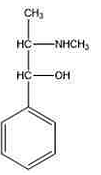
The above structure is of:- Which of the following materials are specified as a suitable diluent for powdered opium
A. Powdered grass
B. Powdered cocoa husk
C. Lactose colored with burnt sugar
D. Powdered digitalis
Choose the correct answer from the options given below: - HPTLC analysis is useful for following types of analysis of herbal drugs
A. Quantitative estimation of marker compound
B. Authentication of extracts
C. Detection of pesticides
D. Standardization of herbal drugs
Choose the correct answer from the options given below: - Anthranilic acid is an immediate precursor in the formation of
- Tropane nucleus is combination of
Top GPAT Introductory Pharmacognosy Questions
- Charaka, a physician belonged to which system of medicine?
- Methanolic extract of a crude drug powder when treated with magensium turnings and concentrated hydrochloric acid turned the solution magenta coloured The test is termed as
- Etoposide and Teniposide are the semisynthetic derivatives of
- Which of the following genera is not the source for tropane alkaloids
- Pterocarpus belongs to which family?
Top GPAT Questions
- Match the symbols in the List I with the terms used in the List II of conductance measurements, and
List I
SymbolsList II
TermsA \(\Omega^{-1}\) I Specific conductance B \(∧\) II Electrical conductance C k III Specific resistance D \(\rho\) IV Equivalent conductance
Choose the correct answer from the options given below: - Cottrell’s method is used for the measurement of:
- Match the statements in List I with their correct answers in List II, respectively, in respect to modified 1st law of thermodynamics, and
List I
List II
A Constant heat (q = 0) I Isothermal B Reversible process at constant temperature (dT = 0) II Isometric C Constant volume (dV = 0) III Adiabatic D Constant pressure (dP = 0) IV Isobar
Choose the correct answer from the options given below: - Boric acid with molecular weight 61.83 was partitioned between water and amyl alcohol at 25 °C. The amount of boric acid was determined to be 0.24 g in 250 ml of amyl alcohol and 0.32 g in 100 ml water. The partition coefficient of boric acid between water and amyl alcohol, when calculated at molar concentration for each of the solution, is:
- Drugs ‘A’, ‘B’ and ‘C’ follow zero order, first order and second order degradation kinetics, respectively, but have the same rate constant. Which of the following statement is true in this respect: