In which limit test is Thioglycolic acid used:
Show Hint
- Limit test for arsenic
- Limit test for sulphate
- Limit test for iron
- Limit test for chloride

The Correct Option is C
Approach Solution - 1
Step 1: Understanding the use of Thioglycolic acid in limit tests. Thioglycolic acid is a chelating agent used in analytical chemistry. In the limit test for iron, it acts as a reducing agent, converting ferric ions (Fe\(^{3+}\)) into ferrous ions (Fe\(^{2+}\)).
Step 2: Role in the limit test for iron. - In this test, Thioglycolic acid reacts with Fe\(^{3+}\), reducing it to Fe\(^{2+}\), which then forms a pink to purple-colored complex with o-phenanthroline in an acidic medium. - The intensity of this color is compared against a standard solution to determine the permissible limit of iron impurities.
Step 3: Why other options are incorrect.
- (A) Limit test for arsenic: Uses Gutzeit or Marsh’s test, involving hydrogen sulfide or silver diethyldithiocarbamate.
- (B) Limit test for sulphate: Uses barium chloride, not thioglycolic acid.
- (D) Limit test for chloride: Uses silver nitrate, forming a white precipitate of silver chloride (AgCl).
Approach Solution -2
The question asks in which pharmacopoeial limit test thioglycolic acid is used as a reagent. Since each limit test relies on a distinct chemical reaction to reveal the impurity being checked, matching thioglycolic acid's chemistry to each test shows where it belongs.
- Limit test for arsenic: This test relies on generating arsine gas, using zinc and an acid or stannous chloride and potassium iodide, which then reacts with mercuric chloride paper or produces a colored complex. Thioglycolic acid plays no part in this reaction.
- Limit test for sulphate: This test detects sulphate through turbidity formed with barium chloride in an acidic medium. It does not involve thioglycolic acid at any step.
- Limit test for iron: Thioglycolic acid acts as a reducing agent in this test, converting ferric ions (\(Fe^{3+}\)) to ferrous ions (\(Fe^{2+}\)). The ferrous ions then form a pink to purple colored complex with a reagent such as ammonium citrate and ammonia, and the intensity of this color, compared against a standard, indicates the amount of iron present. This is the specific role thioglycolic acid plays.
- Limit test for chloride: This test detects chloride through the white precipitate formed when silver nitrate reacts with chloride ions. Thioglycolic acid is not part of this reaction either.
Only the iron limit test depends on thioglycolic acid's reducing action to generate the colored complex used for comparison.
Therefore, the correct answer is Limit test for iron.
Top GPAT Organic Chemistry Questions
- Given below are the two statements
Statement I: Glucose‐6‐phosphate can be formed from glucose, but not from glycogen.
Statement II: Glucose‐1‐phosphate may be hydrolyzed to yield free glucose in liver.
Choose the most appropriate answer from the options given below: - Optically active mandelic acid can be synthesized from benzaldehyde in the presence of the enzyme:
- In the determination of configuration of glucose, Fischer subjected (‐) arabinose to Ruff’s degradation. The four‐carbon sugar obtained by the degradation process was:
- Insertion of a oxygen in a carbonyl compound to form an ester is known as:
- Controlled alkylation of a ketone via an enamine intermediate is named as:
Top GPAT Organic Chemistry Questions
- The hydrogen deficiency index for a compound with molecular formula \(C_{13}H_9N_2O_4BrS\) is
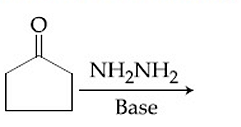
- Product of the following reaction:
- An aldopentose can be converted into aldohexose by:
- Propanone and 2-hydroxy propene are;
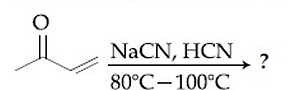
- What is the product of the following reaction?
Top GPAT Questions
- Match the symbols in the List I with the terms used in the List II of conductance measurements, and
List I
SymbolsList II
TermsA \(\Omega^{-1}\) I Specific conductance B \(∧\) II Electrical conductance C k III Specific resistance D \(\rho\) IV Equivalent conductance
Choose the correct answer from the options given below: - Cottrell’s method is used for the measurement of:
- Match the statements in List I with their correct answers in List II, respectively, in respect to modified 1st law of thermodynamics, and
List I
List II
A Constant heat (q = 0) I Isothermal B Reversible process at constant temperature (dT = 0) II Isometric C Constant volume (dV = 0) III Adiabatic D Constant pressure (dP = 0) IV Isobar
Choose the correct answer from the options given below: - Boric acid with molecular weight 61.83 was partitioned between water and amyl alcohol at 25 °C. The amount of boric acid was determined to be 0.24 g in 250 ml of amyl alcohol and 0.32 g in 100 ml water. The partition coefficient of boric acid between water and amyl alcohol, when calculated at molar concentration for each of the solution, is:
- Drugs ‘A’, ‘B’ and ‘C’ follow zero order, first order and second order degradation kinetics, respectively, but have the same rate constant. Which of the following statement is true in this respect: