In Michaelis-Menten equation when \( K_m = C \):
Show Hint
- \( \text{The rate of process is equal to half of maximum rate} \)
- \( \text{Indicates zero-order process} \)
- \( \text{The rate process occurs at a constant rate} \)
- \( \text{Equation becomes identical to first-order elimination of drug} \)

The Correct Option is A
Approach Solution - 1
Step 1: Michaelis-Menten equation. The Michaelis-Menten equation is given by: \[ v = \frac{V_{\text{max}} \cdot [S]}{K_m + [S]} \] where: - \( v \) is the reaction rate, - \( V_{\text{max}} \) is the maximum rate, - \( [S] \) is the substrate concentration, - \( K_m \) is the Michaelis constant (substrate concentration at which the reaction rate is half of \( V_{\text{max}} \)).
Step 2: Condition when \( K_m = C \). When \( [S] = K_m \): \[ v = \frac{V_{\text{max}} \cdot K_m}{K_m + K_m} = \frac{V_{\text{max}}}{2} \] This shows that the rate of the process is equal to half of the maximum rate (\( V_{\text{max}} \)) when the substrate concentration equals the Michaelis constant (\( K_m \)).
Step 3: Comparison with other options. - Option \( (B) \): Zero-order kinetics occur when \( [S] \gg K_m \).
- Option \( (C) \): Constant rate occurs in zero-order kinetics.
- Option \( (D) \): First-order elimination occurs when \( [S] \ll K_m \).
Conclusion: The correct answer is \( (A) \).
Approach Solution -2
The Michaelis constant \( K_m \) has a built-in physical meaning: it is defined as the substrate concentration at which the reaction runs at exactly half its maximum possible rate. The question is asking what happens when the substrate concentration \( C \) equals \( K_m \), so let's check each option against that definition.
- The rate of process is equal to half of maximum rate: This is the textbook definition of \( K_m \) itself, the substrate concentration at which the enzyme is working at exactly half of its top speed \( V_{max} \). Setting the substrate concentration equal to \( K_m \) is, by definition, the condition this statement describes.
- Indicates zero-order process: A zero-order process happens when substrate concentration is far higher than \( K_m \), so the enzyme is fully saturated and the rate no longer depends on how much more substrate is added. Setting \( [S] = K_m \) is nowhere near this saturating condition.
- The rate process occurs at a constant rate: A constant rate independent of substrate concentration is another way of describing zero-order behavior, which again only happens at substrate concentrations well above \( K_m \), not when they are equal.
- Equation becomes identical to first-order elimination of drug: First-order behavior, where rate is directly proportional to substrate concentration, shows up when substrate concentration is much lower than \( K_m \), the opposite extreme from setting them equal.
Since \( K_m \) is defined as the substrate concentration giving half-maximal rate, the condition \( [S] = K_m \) directly matches the first option, while zero-order and first-order behavior only appear at the two opposite extremes, far above or far below \( K_m \).
So the correct answer is The rate of process is equal to half of maximum rate.
Top GPAT Pharmacognosy Questions
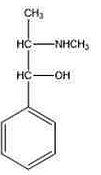
The above structure is of:- Which of the following materials are specified as a suitable diluent for powdered opium
A. Powdered grass
B. Powdered cocoa husk
C. Lactose colored with burnt sugar
D. Powdered digitalis
Choose the correct answer from the options given below: - HPTLC analysis is useful for following types of analysis of herbal drugs
A. Quantitative estimation of marker compound
B. Authentication of extracts
C. Detection of pesticides
D. Standardization of herbal drugs
Choose the correct answer from the options given below: - Anthranilic acid is an immediate precursor in the formation of
- Tropane nucleus is combination of
Top GPAT Enzymes Questions
- Nitric oxide synthase exists in ____.
- Class of enzymes which use oxygen as a hydrogen acceptor are known as
- The rheological and functional properties of synovial fluid are impaired due to :
- Active site for all serine proteases consists of which triad
- Match List I and List IIChoose the correct answer from the options given below:
List I Name of Vitamin List II Functions of Vitamins A Riboflavin I The electron acceptor for isocitrate dehydro- genase B Niacin II Decarboxylation of alpha-ketoglutarate dehydrogenas C Thiamine III Part of coenzyme A D Pantothenic acid IV Cofactor for succinate dehydrogenase V Enzyme activity regulator, such as for protein kinase C
Top GPAT Questions
- Match the symbols in the List I with the terms used in the List II of conductance measurements, and
List I
SymbolsList II
TermsA \(\Omega^{-1}\) I Specific conductance B \(∧\) II Electrical conductance C k III Specific resistance D \(\rho\) IV Equivalent conductance
Choose the correct answer from the options given below: - Cottrell’s method is used for the measurement of:
- Match the statements in List I with their correct answers in List II, respectively, in respect to modified 1st law of thermodynamics, and
List I
List II
A Constant heat (q = 0) I Isothermal B Reversible process at constant temperature (dT = 0) II Isometric C Constant volume (dV = 0) III Adiabatic D Constant pressure (dP = 0) IV Isobar
Choose the correct answer from the options given below: - Boric acid with molecular weight 61.83 was partitioned between water and amyl alcohol at 25 °C. The amount of boric acid was determined to be 0.24 g in 250 ml of amyl alcohol and 0.32 g in 100 ml water. The partition coefficient of boric acid between water and amyl alcohol, when calculated at molar concentration for each of the solution, is:
- Drugs ‘A’, ‘B’ and ‘C’ follow zero order, first order and second order degradation kinetics, respectively, but have the same rate constant. Which of the following statement is true in this respect: