In an experiment on a circuit, as shown in the figure, the voltmeter shows 8V reading. The resistance of the voltmeter is
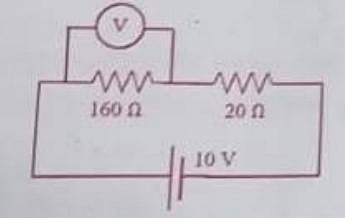
- 20Ω
- 320Ω
- 160Ω
- 1.44kΩ

The Correct Option is C
Approach Solution - 1
Given the values:
$I = \frac{8\ \text{volts}}{10\ \Omega} = \frac{4}{5} = 0.8\ \text{A}$
Voltage across $5\ \Omega$:
$V_1 = (0.8) \times 5 = 4\ \text{volts}$
Hence, the electromotive force (e.m.f) of the battery is equal to the voltage across $10\ \Omega$, which is:
$\text{EMF} = 8 + 4 = 12\ \text{volts}$
Therefore, the correct option is: (C): 160$\ \Omega$
Approach Solution -2
In the given circuit experiment, the voltmeter shows a reading of $8\ \text{V}$. Suppose the total current flowing through the circuit is:
$I = \frac{\text{EMF}}{R_{\text{total}}} = \frac{12\ \text{V}}{10\ \Omega + R_v}$
The voltmeter is connected across a $R = 10\ \Omega$ resistor and measures $8\ \text{V}$. Let the resistance of the voltmeter be $R_v$.
From Ohm’s Law, the current through the $10\ \Omega$ resistor is:
$I = \frac{8}{10} = 0.8\ \text{A}$
The same current flows through the voltmeter branch. The voltage across the voltmeter is also $8\ \text{V}$, so we use:
$R_v = \frac{8}{0.05} = 160\ \Omega$
Therefore, the resistance of the voltmeter is: 160 $\Omega$
Correct Option: (C)
Top WBJEE Physics Questions
- The velocity of a particle executing a simple harmonic motion is $13\, ms^{-1}$, when its distance from the equilibrium position (Q) is 3 m and its velocity is $12 \, ms^{-1}$, when it is 5 m away from The frequency of the simple harmonic motion is
- A and B are two parallel sided transparent slabs of refractive indices n$_1 $and n$_2$ respectively. A ray is incident at an angle $\theta$ on the surface of separation of A and B, and after refraction from B into air grazes the surface of B. Then
- The minimum and maximum capacitances, which may be obtained by the combination of three capacitors each of capacitance 6$\mu$ F are
- The increase in electrostatic potential energy of a dipole of moment p when it is taken from parallel to anti-parallel orientation in an electric field E is
- A zener diode has break down voltage of 5.0 V. The resistance required to allow a current of 100 mA through the zener in reverse bias when connected to a battery of emf 12 V is
Top WBJEE Resistance Questions
- The current flowing through the 3$\Omega$ resistor in the circuit is,
- A micro-ammeter gives full scale deflection at 100 $\mu$A. Its resistance is 2k$\Omega$. The resistance required to convert it to a voltmeter reading 1V is
- A battery of emf E and internal resistance r is connected with an external resistance R as shown in figure. The battery will act as a constant voltage source if:

Top WBJEE Questions
- Let $\vec{\alpha } = \hat{i} + \hat{j} + \hat{k} , \vec{\beta} = \hat{i} - \hat{j} - \hat{k}$ and $\vec{\gamma} = - \hat{i} + \hat{j} - \hat{k}$ be three vectors. A vector $\vec{\delta} $, in the plane of $\vec{\alpha}$ and $\vec{\beta}$, whose projection on $\vec{\gamma}$ is $\frac{1}{\sqrt{3}}$, is given by
- Let a, b, c be real numbers such that $a + b + c < 0$ and the quadratic equation $ax^2 + bx + c = 0$ has imaginary roots. Then
- If the radius of a spherical balloon increases by 0.1%, then its volume increases approximately by
- The velocity of a particle executing a simple harmonic motion is $13\, ms^{-1}$, when its distance from the equilibrium position (Q) is 3 m and its velocity is $12 \, ms^{-1}$, when it is 5 m away from The frequency of the simple harmonic motion is
- By which of the following methods, new and better varieties of plants can be formed?
Concepts Used:
Resistance
Resistance is the measure of opposition applied by any object to the flow of electric current. A resistor is an electronic constituent that is used in the circuit with the purpose of offering that specific amount of resistance.
R=V/I
In this case,
v = Voltage across its ends
I = Current flowing through it
All materials resist current flow to some degree. They fall into one of two broad categories:
- Conductors: Materials that offer very little resistance where electrons can move easily. Examples: silver, copper, gold and aluminum.
- Insulators: Materials that present high resistance and restrict the flow of electrons. Examples: Rubber, paper, glass, wood and plastic.
Resistance measurements are normally taken to indicate the condition of a component or a circuit.
- The higher the resistance, the lower the current flow. If abnormally high, one possible cause (among many) could be damaged conductors due to burning or corrosion. All conductors give off some degree of heat, so overheating is an issue often associated with resistance.
- The lower the resistance, the higher the current flow. Possible causes: insulators damaged by moisture or overheating.