Question:
A battery of emf E and internal resistance r is connected with an external resistance R as shown in figure. The battery will act as a constant voltage source if:
A battery of emf E and internal resistance r is connected with an external resistance R as shown in figure. The battery will act as a constant voltage source if:
Updated On: Jan 29, 2026
- r ,<< R
- r>> R
- r = R
- It will never act as a constant voltage source
Show Solution

Verified By Collegedunia
The Correct Option is A
Solution and Explanation
Given:
A battery of emf \( E \) and internal resistance \( r \) is connected in series with an external resistance \( R \).
Concept:
The voltage across the external resistance \( R \) is given by: \[ V = E - Ir \] where \( I = \frac{E}{R + r} \) So the voltage across \( R \) becomes: \[ V = E - \left( \frac{E}{R + r} \right) r = \frac{E R}{R + r} \]
For the battery to act as a constant voltage source:
The voltage across the external resistance \( V \approx E \). This happens when the drop across internal resistance is negligible. \[ \text{This implies } r \ll R \]
Therefore, the battery will act as a constant voltage source when:
r << R
Was this answer helpful?
0
0
Top WBJEE Physics Questions
- The velocity of a particle executing a simple harmonic motion is $13\, ms^{-1}$, when its distance from the equilibrium position (Q) is 3 m and its velocity is $12 \, ms^{-1}$, when it is 5 m away from The frequency of the simple harmonic motion is
- A and B are two parallel sided transparent slabs of refractive indices n$_1 $and n$_2$ respectively. A ray is incident at an angle $\theta$ on the surface of separation of A and B, and after refraction from B into air grazes the surface of B. Then
- The minimum and maximum capacitances, which may be obtained by the combination of three capacitors each of capacitance 6$\mu$ F are
- The increase in electrostatic potential energy of a dipole of moment p when it is taken from parallel to anti-parallel orientation in an electric field E is
- A zener diode has break down voltage of 5.0 V. The resistance required to allow a current of 100 mA through the zener in reverse bias when connected to a battery of emf 12 V is
View More Questions
Top WBJEE Resistance Questions
- The current flowing through the 3$\Omega$ resistor in the circuit is,
- A micro-ammeter gives full scale deflection at 100 $\mu$A. Its resistance is 2k$\Omega$. The resistance required to convert it to a voltmeter reading 1V is
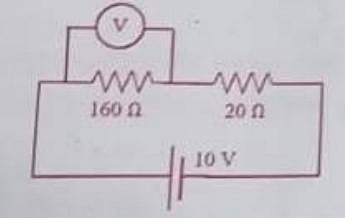
- In an experiment on a circuit, as shown in the figure, the voltmeter shows 8V reading. The resistance of the voltmeter is
Top WBJEE Questions
- Let $\vec{\alpha } = \hat{i} + \hat{j} + \hat{k} , \vec{\beta} = \hat{i} - \hat{j} - \hat{k}$ and $\vec{\gamma} = - \hat{i} + \hat{j} - \hat{k}$ be three vectors. A vector $\vec{\delta} $, in the plane of $\vec{\alpha}$ and $\vec{\beta}$, whose projection on $\vec{\gamma}$ is $\frac{1}{\sqrt{3}}$, is given by
- Let a, b, c be real numbers such that $a + b + c < 0$ and the quadratic equation $ax^2 + bx + c = 0$ has imaginary roots. Then
- If the radius of a spherical balloon increases by 0.1%, then its volume increases approximately by
- The velocity of a particle executing a simple harmonic motion is $13\, ms^{-1}$, when its distance from the equilibrium position (Q) is 3 m and its velocity is $12 \, ms^{-1}$, when it is 5 m away from The frequency of the simple harmonic motion is
- By which of the following methods, new and better varieties of plants can be formed?
View More Questions