If (i) A=\(\begin{bmatrix} \cos\alpha & \sin\alpha\\ -\sin\alpha & \cos\alpha \end{bmatrix}\),then verify that A'A=I
(ii) A= \(\begin{bmatrix} \sin\alpha & \cos\alpha\\ -\cos \alpha & \sin\alpha \end{bmatrix}\),then verify that A'A=I
(ii) A= \(\begin{bmatrix} \sin\alpha & \cos\alpha\\ -\cos \alpha & \sin\alpha \end{bmatrix}\),then verify that A'A=I

Solution and Explanation
(i) \(A=\) \(\begin{bmatrix} \cos\alpha & \sin\alpha\\ -\sin\alpha & \cos\alpha \end{bmatrix}\)
\(\therefore A'=\) \(\begin{bmatrix} \cos\alpha & -\sin\alpha\\ \sin\alpha & \cos\alpha \end{bmatrix}\)
A'A= \(\begin{bmatrix} \cos\alpha & -\sin\alpha\\ \sin\alpha & \cos\alpha \end{bmatrix}\) \(\begin{bmatrix} \cos\alpha & \sin\alpha\\ -\sin\alpha & \cos\alpha \end{bmatrix}\)
= \(\begin{bmatrix} (\cos\alpha) (cos\alpha) + (- \sin\alpha)( -\sin\alpha) & (\cos\alpha)(\sin\alpha)+(-\sin\alpha)(\cos\alpha)\\ (\sin\alpha)(\cos\alpha)+(\cos\alpha)(-\sin\alpha) & (\sin\alpha)(\sin\alpha)+(\cos\alpha)(\cos\alpha) \end{bmatrix}\)
= \(\begin{bmatrix} \cos^2α+\sin^2α & \sinα\cosα-\sinα\cosα\\ \ sinα\cosα-\sinα\cosα & \sin^2α+\cos^2α \end{bmatrix}\)
= \(\begin{bmatrix} 1 & 0\\ 0 & 1 \end{bmatrix}= I\)
Hence we verified that: A'A=I
(ii) \(\begin{bmatrix} \sin\alpha & \cos\alpha\\ -\cos\alpha & \sin\alpha \end{bmatrix}\)
so A'= \(\begin{bmatrix} \sin\alpha & -\cos\alpha\\ \cos\alpha & \sin\alpha \end{bmatrix}\)
A'A= \(\begin{bmatrix} \sin\alpha & -\cos\alpha\\ \cos\alpha & \sin\alpha \end{bmatrix}\)\(\begin{bmatrix} \sin\alpha & \cos\alpha\\ -\cos\alpha & \sin\alpha \end{bmatrix}\)
= \(\begin{bmatrix} (\sin\alpha)(\sin\alpha)+(-\cos\alpha)(-\cos\alpha) & (\sin\alpha)(\cos\alpha)+(-\cos\alpha)(\sin\alpha)\\ (\cos\alpha)(\sin\alpha)+(\sin\alpha)(-\cos\alpha) & (\cos\alpha)(\cos\alpha)+(\sin\alpha)(\sin\alpha) \end{bmatrix}\)
= \(\begin{bmatrix} \sin^2α\cos^2α & \sinα\cosα-\sin\alpha\cos\alpha & \\ \sinα\cosα-\sinα\cosα & \cos^2α+\sin^2α \end{bmatrix}\)
= \(\begin{bmatrix} 1 & 0\\ 0 & 1 \end{bmatrix}= I\)
Hence we verified that: \(A'A=I\)
Top CBSE CLASS XII Mathematics Questions
- 2, b, c are in A.P. and the range of determinant $\begin{vmatrix}1&1&1\\ 2&b&c\\ 4&b^{2}&c^{2}\end{vmatrix}$ is [2, 16]. Then find range of c is
- A committee of 11 members is to be formed from 8 males and 5 females. Let m denotes the number of ways of selecting committee having atleast 6 males and n denotes the number of ways of selecting atleast 3 females then
Determine whether each of the following relations are reflexive, symmetric, and transitive.
- Relation R in the set A={1,2,3,...13,14} defined as R={(x,y): 3x-y=0}.
- Relation R in the set of N natural numbers defined as R={(x,y): y=x+5 and x<4}.
- Relation R in the set A={1,2,3,4,5,6} defined as R={(x,y): y is divisible by x}.
- Relation R in the set of Z integers defined as R={(x,y): x-y is an integer}
- Relation R in the set of human beings in a town at a particular time given by
- R={(x,y): x and y work at same place}
- R={(x,y): x and y live in the same locality}
- R={(x,y): x is exactly 7 am taller that y}
- R={(x,y): x is wife of y}
- R={(x,y):x is father of y}
Show that the relation R in the set R of real numbers, defined as
R = {(a, b): a ≤ b2 } is neither reflexive nor symmetric nor transitive.Check whether the relation R defined in the set {1, 2, 3, 4, 5, 6} as
R = {(a, b): b = a + 1} is reflexive, symmetric or transitive.
Top CBSE CLASS XII Matrices Questions
In the matrix A= \(\begin{bmatrix} 2 & 5 & 19&-7 \\ 35 & -2 & \frac{5}{2}&12 \\ \sqrt3 & 1 & -5&17 \end{bmatrix}\),write:
I. The order of the matrix
II. The number of elements
III. Write the elements a13, a21, a33, a24, a23If a matrix has 24 elements, what are the possible order it can have? What, if it has 13 elements?
If a matrix has 18 elements, what are the possible orders it can have? What, if it has 5 elements?
Construct a 3×4 matrix, whose elements are given by
I. \(a_{ij}=\frac{1}{2}\mid -3i+j\mid\)
II. \(a_{ij}=2i-j\)Find the value of x, y, and z from the following equation:
I.\(\begin{bmatrix} 4&3&\\x&5\end{bmatrix}=\begin{bmatrix}y&z\\1&5\end{bmatrix}\)II. \(\begin{bmatrix}x+y&2\\5+z&xy\end{bmatrix}=\begin{bmatrix}6&2\\5&8\end{bmatrix}\)
III. \(\begin{bmatrix}x+y+z\\x+z\\y+z\end{bmatrix}=\begin{bmatrix}9\\5\\7\end{bmatrix}\)
Top CBSE CLASS XII Questions
- 2, b, c are in A.P. and the range of determinant $\begin{vmatrix}1&1&1\\ 2&b&c\\ 4&b^{2}&c^{2}\end{vmatrix}$ is [2, 16]. Then find range of c is
- A boy of mass 50 kg is standing at one end of a, boat of length 9 m and mass 400 kg. He runs to the other, end. The distance through which the centre of mass of the boat boy system moves is
- A capillary tube of radius r is dipped inside a large vessel of water. The mass of water raised above water level is M. If the radius of capillary is doubled, the mass of water inside capillary will be
- A circular disc is rotating about its own axis. An external opposing torque 0.02 Nm is applied on the disc by which it comes rest in 5 seconds. The initial angular momentum of disc is
- A circular disc is rotating about its own axis at uniform angular velocity \(\omega.\) The disc is subjected to uniform angular retardation by which its angular velocity is decreased to \(\frac {\omega}{2}\) during 120 rotations. The number of rotations further made by it before coming to rest is
Concepts Used:
Transpose of a Matrix
The matrix acquired by interchanging the rows and columns of the parent matrix is called the Transpose matrix. The transpose matrix is also defined as - “A Matrix which is formed by transposing all the rows of a given matrix into columns and vice-versa.”
The transpose matrix of A is represented by A’. It can be better understood by the given example:
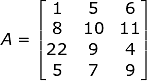
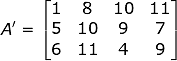
Now, in Matrix A, the number of rows was 4 and the number of columns was 3 but, on taking the transpose of A we acquired A’ having 3 rows and 4 columns. Consequently, the vertical Matrix gets converted into Horizontal Matrix.
Hence, we can say if the matrix before transposing was a vertical matrix, it will be transposed to a horizontal matrix and vice-versa.
Read More: Transpose of a Matrix