How did Hershey and Chase differentiate between DNA and protein in their experiment while proving that DNA is the genetic material?

Solution and Explanation
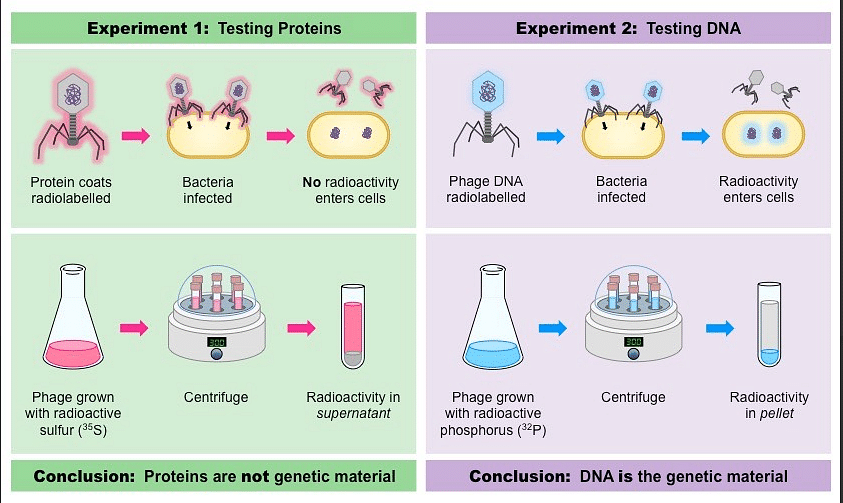
Hershey and Chase worked with bacteriophage and E. coli to prove that DNA is the genetic material. They used different radioactive isotopes to label DNA and protein
coat of the bacteriophage.
They grew some bacteriophages on a medium containing radioactive phosphorus (32P) to identify DNA and some on a medium containing radioactive sulphur (35S) to identify protein. Then these radioactive labelled phages were allowed to infect E. coli bacteria. After infecting the protein coat of the bacteriophage was seperated from the bacterial cell by blending and then subjected to the process of centrifugation. Since the protein coat was lighter it was found in the supernatant while the infected bacteria got settled at the bottom of the centrifuge tube. Hence it was proved that DNA is the genetic material as it was transferred from virus to bacteria.
Top CBSE CLASS XII Biology Questions
- All algae have
- With a neat, labelled diagram, describe the parts of a typical angiosperm ovule.
- With a neat diagram explain the 7-celled, 8-nucleate nature of the female gametophyte
- Draw a labeled diagram of male reproductive system.
- Draw a labeled diagram of female reproductive system.
Top CBSE CLASS XII Molecular Basis of Inheritance Questions
- Which property of DNA double helix led Watson and Crick to hypothesise semiconservative mode of DNA replication? Explain.
Briefly describe the following:
(a) Transcription
(b) Polymorphism
(c) Translation
(d) Bioinformatics
- Group the following as nitrogenous bases and nucleosides: Adenine, Cytidine, Thymine, Guanosine, Uracil and Cytosine.
- If a double standard DNA has 20 per cent of cytosine calculate the per cent of adenine in the DNA.
If the sequence of the coding strand in a transcription unit is written as follows:
5-ATGCATGCATGCATGCATGCATGCATGC-3
Write down the sequence of mRNA.
Top CBSE CLASS XII Questions
- 2, b, c are in A.P. and the range of determinant $\begin{vmatrix}1&1&1\\ 2&b&c\\ 4&b^{2}&c^{2}\end{vmatrix}$ is [2, 16]. Then find range of c is
- A boy of mass 50 kg is standing at one end of a, boat of length 9 m and mass 400 kg. He runs to the other, end. The distance through which the centre of mass of the boat boy system moves is
- A capillary tube of radius r is dipped inside a large vessel of water. The mass of water raised above water level is M. If the radius of capillary is doubled, the mass of water inside capillary will be
- A circular disc is rotating about its own axis. An external opposing torque 0.02 Nm is applied on the disc by which it comes rest in 5 seconds. The initial angular momentum of disc is
- A circular disc is rotating about its own axis at uniform angular velocity \(\omega.\) The disc is subjected to uniform angular retardation by which its angular velocity is decreased to \(\frac {\omega}{2}\) during 120 rotations. The number of rotations further made by it before coming to rest is
Concepts Used:
Non-Mendelian Genetics
The term - non-mendelian inheritance refers to any pattern of heredity in which features do not separate according to Mendel's laws. These principles describe how features linked with single genes on chromosomes in the nucleus are passed down through generations.
Types of Non-Mendelian Inheritance
Codominance Inheritance
It is a form of incomplete dominance in which both alleles for the same feature are expressed in the heterozygote at the same time. For example, the MN blood types of humans.
Incomplete Dominance
In a heterozygote, the dominant allele does not always completely cover the phenotypic expression of the recessive gene, resulting in an intermediate phenotype which is referred to as "incomplete dominance”.