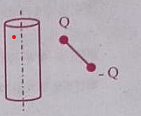
Consider a positively charged infinite cylinder with uniform volume charge density \(\rho>0\). An electric dipole consisting of +Q and -Q charges attached to opposite ends of a massless rod is oriented as shown in the figure. At the instant as shown in the figure, the dipole will experience,
a force to the right and a counter-clockwise torque
no force but only a clockwise torque.
Show Solution
Verified By Collegedunia
The Correct Option isB
Approach Solution - 1
Given:
An infinite cylinder with positive uniform charge density $\rho > 0$
An electric dipole made of charges $+Q$ and $-Q$, connected by a massless rod
The dipole is placed such that the two charges are at different distances from the axis
Electric field inside the cylinder:
The electric field at a distance $r$ from the axis is given by: $\vec{E}(r) = \dfrac{\rho r}{2\varepsilon_0} \hat{r}$
This means the field is radially outward and increases with $r$.
Effect on the dipole:
The $+Q$ charge is farther from the axis, so it experiences a stronger force outward.
The $-Q$ charge is closer, so it experiences a weaker inward force.
Thus, there is a net force to the right (outward).
The forces form a couple (since they are not collinear), causing a clockwise torque.
Conclusion:
The dipole experiences a force to the right and a clockwise torque.
Correct option: (B): a force to the right and a clockwise torque
Was this answer helpful?
3
2
Show Solution
Verified By Collegedunia
Approach Solution -2
Consider a positively charged infinite cylinder with a uniform volume charge density ρ > 0. An electric dipole consisting of +Q and -Q charges attached to opposite ends of a massless rod is oriented as shown in the figure At the instant shown in the figure, the dipole will experience: A force due to the electric field created by the charged cylinder.A torque that will try to align the dipole with the electric field.
An electric dipole is a pair of equal and opposite point charges -q and q, separated by a distance of 2a. The direction from q to -q is said to be the direction in space.
p=q×2a
where,
p denotes the electric dipole moment, pointing from the negative charge to the positive charge.