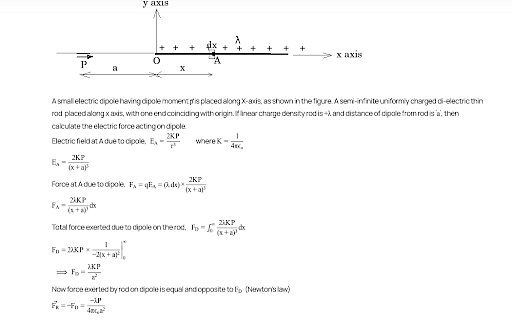
An electric dipole of dipole moment p is placed at the origin of the coordinate system along the z-axis. The amount of work required to move a charge 'q' from the point (a,0,0) to the point (0,0,a) is
- \(\frac{pq}{4\pi\epsilon_0a}\)
- 0
- \(-\frac{pq}{4\pi\epsilon_0a^2}\)
- \(\frac{pq}{4\pi\epsilon_0a^2}\)

The Correct Option is D
Solution and Explanation
Given:
An electric dipole with dipole moment $\vec{p}$ produces an electric field at a point on the x-axis, making an angle $\theta$ with the axis.
Using the identity:
$\tan \alpha = \frac{1}{2} \tan \theta$, and $\theta = 60^\circ + \alpha$
Electric Field Components:
Resolving the electric field $\vec{E}$ into components:
$E \cos \alpha = \frac{1}{4\pi\epsilon_0} \cdot \frac{2p \cos 60^\circ}{r^3}$ ⟶ (1)
$E \sin \alpha = \frac{1}{4\pi\epsilon_0} \cdot \frac{p \sin 60^\circ}{r^3}$ ⟶ (2)
Dividing (2) by (1):
$\tan \alpha = \frac{1}{2} \tan \theta$
Also given: $\tan \alpha = \tan(\theta + \alpha)$
After simplification and solving, the resulting expression for potential energy is:
Answer: $\frac{pq}{4\pi\epsilon_0 a^2}$
Correct Option: (D)
Top WBJEE Physics Questions
- The velocity of a particle executing a simple harmonic motion is $13\, ms^{-1}$, when its distance from the equilibrium position (Q) is 3 m and its velocity is $12 \, ms^{-1}$, when it is 5 m away from The frequency of the simple harmonic motion is
- A and B are two parallel sided transparent slabs of refractive indices n$_1 $and n$_2$ respectively. A ray is incident at an angle $\theta$ on the surface of separation of A and B, and after refraction from B into air grazes the surface of B. Then
- The minimum and maximum capacitances, which may be obtained by the combination of three capacitors each of capacitance 6$\mu$ F are
- The increase in electrostatic potential energy of a dipole of moment p when it is taken from parallel to anti-parallel orientation in an electric field E is
- A zener diode has break down voltage of 5.0 V. The resistance required to allow a current of 100 mA through the zener in reverse bias when connected to a battery of emf 12 V is
Top WBJEE Electric Dipole Questions
Top WBJEE Questions
- Let $\vec{\alpha } = \hat{i} + \hat{j} + \hat{k} , \vec{\beta} = \hat{i} - \hat{j} - \hat{k}$ and $\vec{\gamma} = - \hat{i} + \hat{j} - \hat{k}$ be three vectors. A vector $\vec{\delta} $, in the plane of $\vec{\alpha}$ and $\vec{\beta}$, whose projection on $\vec{\gamma}$ is $\frac{1}{\sqrt{3}}$, is given by
- Let a, b, c be real numbers such that $a + b + c < 0$ and the quadratic equation $ax^2 + bx + c = 0$ has imaginary roots. Then
- If the radius of a spherical balloon increases by 0.1%, then its volume increases approximately by
- The velocity of a particle executing a simple harmonic motion is $13\, ms^{-1}$, when its distance from the equilibrium position (Q) is 3 m and its velocity is $12 \, ms^{-1}$, when it is 5 m away from The frequency of the simple harmonic motion is
- By which of the following methods, new and better varieties of plants can be formed?
Concepts Used:
Electric Dipole
An electric dipole is a pair of equal and opposite point charges -q and q, separated by a distance of 2a. The direction from q to -q is said to be the direction in space.
p=q×2a
where,
p denotes the electric dipole moment, pointing from the negative charge to the positive charge.
Force Applied on Electric Dipole