(a) Figure 9.28 shows a cross-section of a light pipe made of a glass fiber of a refractive index of 1.68. The outer covering of the pipe is made of a material with a refractive index 1.44. What is the range of the angles of the incident rays with the axis of the pipe for which total reflections inside the pipe take place, as shown in the figure? (b)What is the answer if there is no outer covering of the pipe?
(a) Figure 9.28 shows a cross-section of a light pipe made of a glass fiber of a refractive index of 1.68. The outer covering of the pipe is made of a material with a refractive index 1.44. What is the range of the angles of the incident rays with the axis of the pipe for which total reflections inside the pipe take place, as shown in the figure? (b)What is the answer if there is no outer covering of the pipe?

Solution and Explanation
(a) Refractive index of the glass fiber,\(\mu\)1= 1.68
The refractive index of the outer covering of the pipe,\(\mu_2\)= 1.44
The angle of incidence= i
The angle of refraction= r
The angle of incidence at the interface= i'
The refractive index(μ)of the inner core-outer core interface is given as:
\(\mu=\frac{\mu_2}{\mu_1}=\frac{1}{sin\,i'}\)
\(sin\,i'=\frac{\mu_1}{\mu_2}\)
=\(\frac{1.44}{1.68}\)= 0.8571
∴i'= 59º
For the critical angle,total internal reflaction(TIR)takes place only when i>i'.i.e.,i>59º
Maximum angle of reflaction,rmax= 90º-i'= 90º-59º= 31º
Let, imax be the maximum angle of incidence.
The refractive index at the air-glass interface, \(\mu_1\)= 1.68
\(\mu_1\)= \(\frac{sin\,i_{max}}{sin\,r_{max}}\)
sin imax= μ1 sin rmax
= 1.68 sin31º
= 1.68×0.5150
= 0.8652
∴imax= sin-1 0.8652≈60º
Thus, all the rays incident at angles lying in the range 0< i< 60º will suffer total internal reflection.
(b) If the outer covering of the pipe is not present, then:
Refractive index of the outer pipe, μ1= Refractive index of air= 1
For the angle of incidence i=90º, we can write Snell's law at the air-pipe interface as:
\(\frac{sin_i}{sin_r}\)= μ2= 1.68
sinr= \(\frac{sin90^{\circ}}{1.68}\)= \(\frac{1}{1.68}\)
r= sin-1(0.5952)
= 36.5º
∴i'= 90º-36.5º=53.5º
Since i'>r, all incident rays will suffer total internal reflection.
Top CBSE CLASS XII Physics Questions
- A boy of mass 50 kg is standing at one end of a, boat of length 9 m and mass 400 kg. He runs to the other, end. The distance through which the centre of mass of the boat boy system moves is
- A capillary tube of radius r is dipped inside a large vessel of water. The mass of water raised above water level is M. If the radius of capillary is doubled, the mass of water inside capillary will be
- A circular disc is rotating about its own axis. An external opposing torque 0.02 Nm is applied on the disc by which it comes rest in 5 seconds. The initial angular momentum of disc is
- A circular disc is rotating about its own axis at uniform angular velocity \(\omega.\) The disc is subjected to uniform angular retardation by which its angular velocity is decreased to \(\frac {\omega}{2}\) during 120 rotations. The number of rotations further made by it before coming to rest is
- A constant power is supplied to a rotating disc. The relationship between the angular velocity $\omega$ of the disc and number of rotations (n) made by the disc is governed by
Top CBSE CLASS XII Ray optics and optical instruments Questions
A small candle,2.5cm in size is placed at 27cm in front of a concave mirror of radius of curvature 36cm.At what distance from the mirror should a screen be placed in order to obtain a sharp image? Describe the nature and size of the image.If the is moved closer to the mirror, how would the screen have to be moved?
A 4.5cm needle is placed 12cm away from a convex mirror of focal length 15cm. Give the location of the image and the magnification.Describe what happens as the needle is moved farther from the mirror.
A tank is filled with water to a height of 12.5cm. The apparent depth of a needle lying at the bottom of the tank is measured by a microscope to be 9.4cm. What is the refractive index of water? If water is replaced by a liquid of refractive index 1.63 up to the same height, by what distance would the microscope have to be moved to focus on the needle again?

(a)and(b)show the refraction of a ray in air incident at 60° with the normal to a glass-air and water-air interface, respectively. Predict the angle of refraction in glass when the angle of incidence in water is 45° with the normal to a water-glass interface
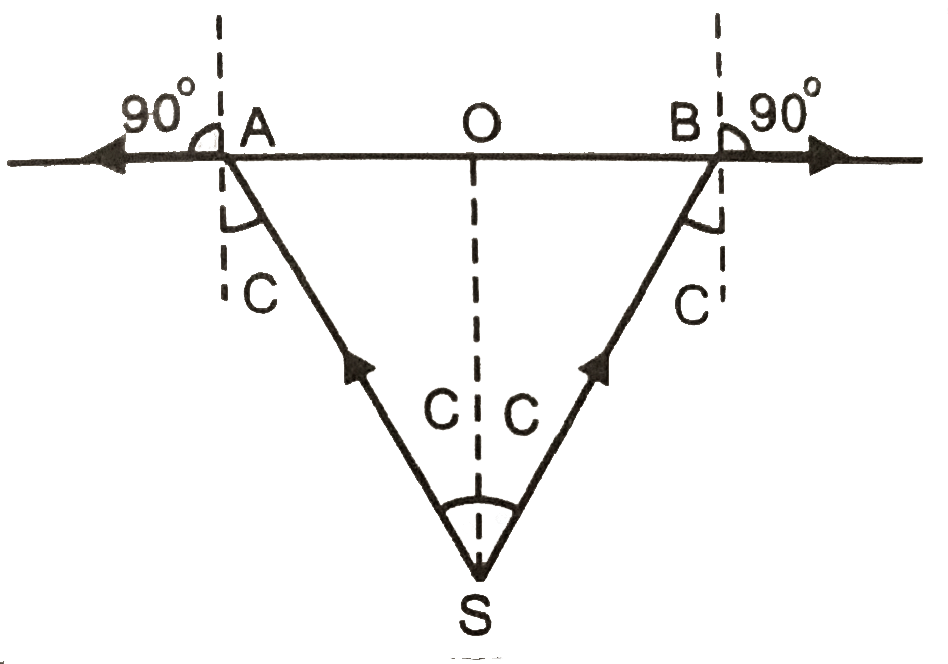
A small bulb is placed at the bottom of a tank containing water to a depth of 80cm. What is the area of the surface of water through which light from the bulb can emerge? The refractive index of water is 1.33. (Consider the bulb to be a point source.)
Top CBSE CLASS XII Questions
- 2, b, c are in A.P. and the range of determinant $\begin{vmatrix}1&1&1\\ 2&b&c\\ 4&b^{2}&c^{2}\end{vmatrix}$ is [2, 16]. Then find range of c is
- A boy of mass 50 kg is standing at one end of a, boat of length 9 m and mass 400 kg. He runs to the other, end. The distance through which the centre of mass of the boat boy system moves is
- A capillary tube of radius r is dipped inside a large vessel of water. The mass of water raised above water level is M. If the radius of capillary is doubled, the mass of water inside capillary will be
- A circular disc is rotating about its own axis. An external opposing torque 0.02 Nm is applied on the disc by which it comes rest in 5 seconds. The initial angular momentum of disc is
- A circular disc is rotating about its own axis at uniform angular velocity \(\omega.\) The disc is subjected to uniform angular retardation by which its angular velocity is decreased to \(\frac {\omega}{2}\) during 120 rotations. The number of rotations further made by it before coming to rest is
Concepts Used:
Ray Optics and Optical Instruments
Optics, deals with the determination of behaviour and the properties of light, along with its interactions with the matter and also with the instruments that are used to detect it.
Ray optics is also known as the geometrical optics and it is a branch of science which describes light propagation.
Reflection is the change in direction of light at an interface in-between two different media so that the wave-front returns into a medium from which it was originated.
Speed of light is the rate at which the light travels in free space.
A phenomenal change in image formed when the light is passed from one medium to another which is called Refraction.
Total Internal Reflection is the reflection of light when the light ray enters into a rarer medium from a denser medium and the angle of incidence is higher than the critical angle of incidence then that light ray will be reflected back to the denser medium.
Read More: Ray Optics and Optical Instruments