List of top Questions asked in CAT

Johannes had been teaching at a seminary in Graz when he was struck by what seemed to him a divine revelation about the structure of the universe. Under the still-prevailing Ptolemaic system of astronomy, the Earth was understood to be immobile in the centre of the universe, surrounded by the fixed stars and seven planets (the sun and the moon were also considered to be planets). Johannes, however, was inclined to put his faith in the revolutionary cosmology proposed by Copernicus in 1543, which placed the sun in the centre, demoting Earth to planet status and the moon to a satellite of Earth. At that time—telescopes had not yet been invented—only the five naked-eye planets were known to exist: Mercury, Venus, Mars, Jupiter and Saturn. Adding Earth...
...to their company brought the total to six. But why, Johannes wondered, had God made only six planets? And why had He arranged their orbits in the particular proportions that He had? There must be an answer: God would not make an unintelligible Universe.
The revelation, which occurred on July 19, 1595, in the middle of teaching a class on planetary alignment, involved the curious geometric properties of Platonic solids. These are three-dimensional polygons, every face of which is identical: A cube is a Platonic solid. So is a tetrahedron (a pyramid with three faces and one base which are all equilateral triangles). It had been understood since Antiquity—and much discussed by Plato, hence the name—that there can only be five such polygons: The laws of geometry forbid any others.
Within a year, Johannes had published this theory in a book, Mysterium Cosmographicum, which he sent to every astronomer and mathematician he could think of, including Galileo and Tycho. The numbers did not exactly agree with the theory, but there was enough of a promising match to give him hope that if he got hold of the best observational data, everything would click into place.
But within a year, Tycho was dead, and Johannes had inherited the role of Imperial Mathematician, finally gaining complete access to all of Tycho’s books. The astronomical data within was so precise, and Johannes so respectful of its precision, that it enabled him to write four monumental treatises based on this data and in the process discover the three foundational laws of modern astronomy: the elliptical nature of planetary orbits; the precise variance of planetary speed; and the exponential relationship between planetary speed and distance from the sun. Three laws upon which Newton built his theory of universal gravitation, laws known to posterity by Johannes’s surname: Kepler. When Newton spoke about standing on the shoulders of giants, it was Johannes Kepler, along with Tycho, Galileo, and Descartes, he had in mind.

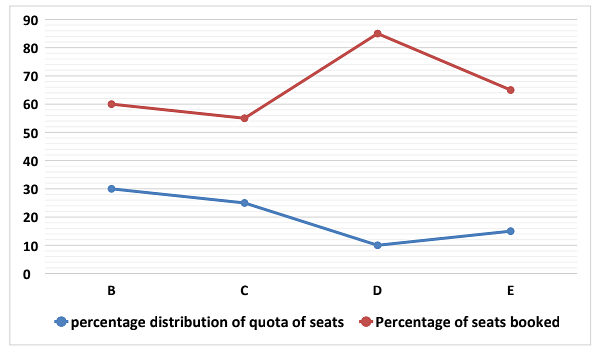
Directions: Study the given information and answer the following questions based on it.
There are three buildings X, Y and Z in a linear row from west to east respectively such that each building has different number of floors. The floors of buildings X and Z are numbered in such a way that the ground floor is numbered 0, first floor is numbered 1, second floor is numbered 2 and so on. The floors of building Y are numbered in such a way that the ground floor is numbered 1, first floor is numbered 2, second floor is numbered 3 and so on. The topmost floor in any building is painted red and the three consecutive floors below it are painted black, white and blue respectively. The floor immediately below the blue floor is painted red and the sequence continues till the ground floor.
NOTE: (i) If the number of floors in between two floors A and B are given, then A and B are in the same building. Also, if A is immediately above/below B then, A and B are in the same building.
(ii) If floor A is in building X and is to the west of floor B, then B can be in building Y or Z and is horizontally aligned with A. In other words, if A is floor no. 5 of building X and is to the west of floor B which is in building Z, then B is also floor no. 5 of building Z.
O's floor is not numbered 0 and has two blue floors above it. Ground floor of building Z is not painted red. W is in building Y and is painted black. W has more than one floor above it. Two floors are in between H and R such that H is below R. H and E are in building X. R is painted blue. T's floor is numbered 0 and is painted with neither blue nor red. Six floors are above E. Floor L is to the east of floor V. The total number of floors in building Y is equal to the floor number of the floor immediately below L. O is painted red and there is no floor below it. G is in floor no. 9. G is neither immediately below V nor is the topmost floor of its building. D is to the immediate east of E and is painted white. Four floors painted red in building Z. N is the topmost floor of its building. The number of floors below N is twice that below D. Q is painted the same colour as E but its floor number is lower than that of E. S is immediately above Q. Two floors are in between M and S. M is not painted the same colour as H. M's floor is not numbered 0. Neither T nor G is adjacent to M.
The passage below contains four questions. Based on the passage, choose the best answer for each question.
The Impressionists openly rejected any philosophical connotations, although their avant-garde approach to painting had important philosophical implications. By drastically diverging from the conventional perspectives of artists on visual reality, they created a logical new mode of artistic expression. Greek painters even made the connection between abstract ideas and concrete shapes, demonstrating their concrete comprehension of the cosmos. This materialistic perspective dominated painting far into the nineteenth century. By contrast, the Impressionists felt that the fundamental element of visual reality was light, not substance. This viewpoint is aptly expressed by the philosopher Taine, who said, "The chief 'person' in a picture is the light in which everything is bathed."
The Impressionists held that all solid objects were connected by light and that any divisions between them were artificial. Solid objects were merely surfaces reflecting light. This alteration altered how color and outline were handled. It was discovered that color resulted from light vibrations on a colorless surface, refuting the earlier belief that color was an intrinsic feature of objects. Originally intended to indicate the edges of an item, outline is currently only used to indicate the boundaries of often overlapping patterns. Impressionist paintings saw the world as a sequence of surfaces reacting to light, rather than as a collection of distinct objects. Filtered light frequently produces the mosaic of colors seen in an Impressionist painting.According to Mauclair, "light becomes the sole subject of the picture," with the objects it illuminates playing a supporting role. This shift means that painting is no longer only a visual art form. This ground-breaking new approach to art appreciation ignored all external ideas, whether they were moral, spiritual, or psychological, as well as any emotions that went beyond the purely aesthetic. The subjects of Impressionist paintings—people, places, and things—did not convey deeper meanings or tell tales. Instead, they merely served as elements of a light pattern that the painter used as inspiration from nature to create on canvas.