Question:
Which one of the following options gives the correct categorisation of animals according to the type of nitrogenous waste they give out?
Ammonotelic
Ureotelic
Uricotelic
(a)
Pigeon, humans
Aquatic amphibia,
lizards
Cockroach frog
(b)
Frog, lizards
Aquatic amphibia humans
Cockroach pigeon
(c)
Aquatic animals
Frog, amphibia, humans
Pigeon, lizards, cockroach
(d)
Aquatic animals
Cockroach, amphibia, humans
Frog, pigeon, lizards
Which one of the following options gives the correct categorisation of animals according to the type of nitrogenous waste they give out?
| Ammonotelic | Ureotelic | Uricotelic | |
|---|---|---|---|
| (a) | Pigeon, humans | Aquatic amphibia, lizards | Cockroach frog |
| (b) | Frog, lizards | Aquatic amphibia humans | Cockroach pigeon |
| (c) | Aquatic animals | Frog, amphibia, humans | Pigeon, lizards, cockroach |
| (d) | Aquatic animals | Cockroach, amphibia, humans | Frog, pigeon, lizards |
Updated On: May 19, 2024
- a
- b
- c
- d
Show Solution

Verified By Collegedunia
The Correct Option is C
Solution and Explanation
Aquatic animals are ammonotelic as they excrete ammonia. Frog, amphibians and humans are ureotelic as they excrete urea. Pigeon, lizards and cockroach are uricotelic as they excrete uric acid
Was this answer helpful?
0
0
Top NEET Biology Questions
- The chronological order of human evolution from early to the recent is
- Upper part of sea/aquatic ecosystem contains
- Where is respiratory electron transport system (ETS) located in plants ?
- Which among the following are the smallest living cells, known without a definite cell wall, pathogenic to plants as well as animals and can survive without oxygen ?
- Three of the following pairs of the human skeletal parts are correctly matched with their respective inclusive skeletal category and one pair is not matched. Identify the non-matching pair. .
Pair of skeletal parts Category (a)$\,\,$ Sternum and ribs$\,\,$ Axial skeleton (b)$\,\,$ Clavicle and glenoid cavity$\,\,$ Pelvic girdle (c)$\,\,$ Flumerus and ulna$\,\,$ Appendicular skeleton (d)$\,\,$ Malleus and stapes$\,\,$ Ear ossicles
View More Questions
Top NEET excretory products and their elimination Questions
- Angiotensinogen is a protein produced and secreted by-
- A decrease in blood pressure / volume will not cause the release of :
- Which of the following does not favour the formation of large quantities of dilute urine?
- Match List I with List II
List I List II A Pons I Provides additional space for Neurons, regulates posture and balance. B Hypothalamus II Controls respiration and gastric secretions. C Medulla III Connects different regions of the brain. D Cerebellum IV Neurosecretory cells
Choose the correct answer from the options given below: - Given below are two statements: one is labelled as Assertion A and the other is labelled as Reason R.
Assertion A: Nephrons are of two types: Cortical & Juxta medullary, based on their relative position in cortex and medulla.
Reason R: Juxta medullary nephrons have short loop of Henle whereas, cortical nephrons have longer loop of Henle.
In the light of the above statements, choose the correct answer from the options given below:
View More Questions
Top NEET Questions
- A $100.0\, mL$ dilute solution of $Ag ^{+}$is electrolysed for $15.0$ minutes with a current of $1.25 \,mA$ and the silver is removed completely. What was the initial $\left[ Ag ^{+}\right]$?
- The time constant of C-R circuit is
- The chronological order of human evolution from early to the recent is
- The correct Boolean operation represented by the circuit diagram drawn is :
- The driver of a car travelling with speed $30\, m/sec$ towards a hill sounds a horn of frequency $600\, Hz.$ If the velocity of sound in air is $330\, m/s,$ the frequency of reflected sound as heard by driver is
View More Questions
Concepts Used:
Excretory products and their elimination
The physiological process of the elimination of metabolic waste from the body is called excretion. The excretory products comprise amino acids, carbon dioxide, urea, uric acid, water, and ammonia. Some of the Molluscs and Echinoderms excrete waste products from the body in the form of amino acids. Ammonia is the foremost excretory product in animals, it is derived from the proteins exists in the food we eat.
Excretory Products in Different Organisms:
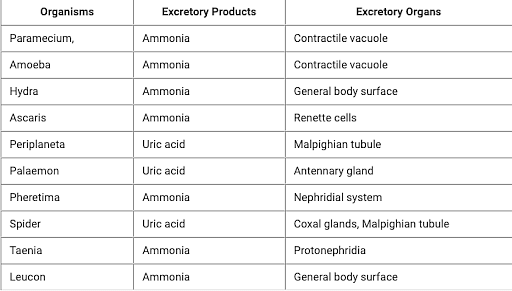
Read More: Excretion in Human Beings