The volume of water (in mL) required to be added to a 100 mL solution (aq. 0.1 M) of a weak acid (HA) at 25 °C to double its degree of dissociation is
[Given: Ka of HA at 25 °C=1.8 x10⁻⁵ ]
[Given: Ka of HA at 25 °C=1.8 x10⁻⁵ ]
- 100
- 200
- 300
- 400

The Correct Option is C
Solution and Explanation
To solve this problem, we need to determine how much additional water should be added to a weak acid solution to double its degree of dissociation.
Given:
- Initial concentration of HA, \([HA]_0 = 0.1 \, \text{M}\)
- Degree of dissociation initially, \(\alpha_1\)
- Dissociation constant, \(K_a = 1.8 \times 10^{-5}\)
The degree of dissociation, \(\alpha\), for a weak acid is given by:
\(\alpha = \sqrt{\frac{K_a}{[HA]_0}}\)
Initial degree of dissociation is:
\(\alpha_1 = \sqrt{\frac{1.8 \times 10^{-5}}{0.1}}\)
\(\alpha_1 = \sqrt{1.8 \times 10^{-4}} = 0.0134\)
We want to double the degree of dissociation:
\(\alpha_2 = 2\alpha_1 = 2 \times 0.0134 = 0.0268\)
The final concentration of the acid after dilution should make the new degree of dissociation equal to \(\alpha_2\):
\(\alpha_2 = \sqrt{\frac{K_a}{[HA]_2}}\)
\(0.0268 = \sqrt{\frac{1.8 \times 10^{-5}}{[HA]_2}}\)
Squaring both sides gives:
\(0.00071824 = \frac{1.8 \times 10^{-5}}{[HA]_2}\)
\([HA]_2 = \frac{1.8 \times 10^{-5}}{0.00071824} = 0.0251 \, \text{M}\)
The concentration changes with dilution. Using the dilution formula:
\(C_1 V_1 = C_2 V_2\)
\(0.1 \times 100 = 0.0251 \times V_2\)
\(V_2 = \frac{10}{0.0251} = 398.41 \, \text{mL}\)
The volume of water to be added is:
\(V_2 - 100 \, \text{mL} = 398.41 - 100 = 298.41 \, \text{mL}\)
Since we need to choose the closest option: 300 mL is the correct volume to add.
Therefore, the correct answer is 300 mL.
Top IIT JAM CY Physical Chemistry Questions
- The diagram that best describes the variation of viscosity (𝜂) of water with temperature at 1 atm is
The SI unit of the molar conductivity of an electrolyte solution is
- The system with the lowest zero-point energy when it is confined to a one dimensional box of length 𝐿 is
- Adsorption of a gas on a solid surface follows the Langmuir isotherm. If \(\frac{ k_a}{k_d}\)=1.0 bar-1 , the fraction of adsorption sites occupied by the gas at equilibrium under 2.0 bar pressure of the gas at 25 °C is
( ka and kd are the rate constants for adsorption and desorption processes, respectively, at 25 °C) - The vapor pressure of a dilute solution of a non-volatile solute and the vapor pressure of the pure solvent at the same temperature are P and P*, respectively. \(\frac{P^*-P}{P^*}\) is equal to
(Assume that the vapor phase behaves as an ideal gas)
Top IIT JAM CY Chemical equilibria Questions
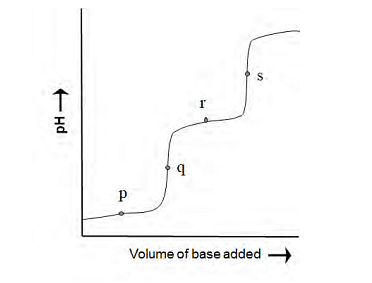
- The following diagram is obtained in a pH-metric titration of a weak dibasic acid (H2A) with a strong base. The point that best represents [HA−]=[A −2 ] is
- The isoelectric point of glutamic acid is ______.
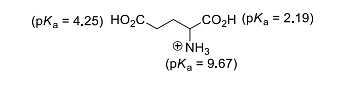
(round off to two decimal places) - The ratio of osmotic pressures of aqueous solutions of 0.01 M BaCl2 to 0.005 M NaCl is
[Given: Both compounds dissociate completely in water] - Consider the exothermic chemical reaction O2(𝑔)+2H2(𝑔) ⇌ 2H2O(𝑔) at equilibrium in a closed container. The correct statement(s) is/are
- 0.1 M aqueous solution of a weak monobasic acid has pH 2.0. The pKa of the monobasic acid is _______. (rounded off to one decimal place)
Top IIT JAM CY Questions
- The structure of Q in the following reaction scheme is.

- The major product of the reaction is

- The rate of addition of 1-hexyl radical to the given molecules follows the order

- The major product of the reaction is

- The diagram that best describes the variation of viscosity (𝜂) of water with temperature at 1 atm is