Question:
The reaction(s) that give(s) meso-1,2-diphenylethane-1,2-diol as the major product is(are)
The reaction(s) that give(s) meso-1,2-diphenylethane-1,2-diol as the major product is(are)
Show Hint
Remember: cis alkene + syn addition = meso; trans alkene + anti addition = meso; the other two combinations give the chiral $d,l$ pair. $OsO_4/NMO$ is syn; $I_2/AgOAc$ then hydrolysis (Prevost) is anti.
Updated On: Aug 10, 2026


Show Solution

Verified By Collegedunia
The Correct Option is A, D
Solution and Explanation
Step 1: Understanding the Question.
1,2-diphenylethane-1,2-diol (hydrobenzoin) has two adjacent stereocenters that carry an identical set of substituents on each side (\(Ph\), \(OH\), \(H\), and the other stereocenter). A molecule like this can exist as a meso form (an internal mirror plane relates the two centers, overall achiral) or as a pair of enantiomers, the \((R,R)\) and \((S,S)\) forms (chiral, optically active, formed together as a racemic, \(d,l\) mixture from an achiral starting alkene). We need to work out which combination of alkene geometry (cis or trans stilbene) and addition mechanism (syn or anti) gives the meso product.
Step 2: The general stereochemical rule for 1,2-diaryl alkenes.
For a symmetric alkene \(Ph-CH=CH-Ph\), syn (cis) addition of two \(OH\) groups to the cis (Z) alkene gives the meso diol, while syn addition to the trans (E) alkene gives the chiral \(d,l\) pair. Anti (trans) addition of two \(OH\) groups to the cis (Z) alkene gives the chiral \(d,l\) pair, while anti addition to the trans (E) alkene gives the meso diol.
In short: (cis alkene + syn addition) and (trans alkene + anti addition) both give meso; the other two combinations give the racemic pair.
Step 3: Identify the addition mode for each reagent set.
\(OsO_4\), \(NMO\) dihydroxylation proceeds through a cyclic osmate ester that delivers both new \(C-O\) bonds from the same face of the double bond, so it is a syn-dihydroxylation.
\(I_2\), \(AgOAc\) (2 equiv), followed by \(NaOH, H_2O\) is the Prevost reaction: the alkene first forms an iodonium ion that is opened by a neighboring acetate (from the second equivalent of \(AgOAc\)) from the face opposite the iodine, and hydrolysis of the resulting diester with aqueous base retains that opposite-face relationship. Because water is only introduced in the hydrolysis step and not during the iodination step, this is the dry (Prevost) pathway, which delivers the two oxygens to opposite faces overall, an anti-dihydroxylation.
Step 4: Apply the rule to each option.
(A) cis-stilbene + \(OsO_4/NMO\) (syn) \(\rightarrow\) cis alkene with syn addition \(\rightarrow\) meso diol. Correct.
(B) trans-stilbene + \(OsO_4/NMO\) (syn) \(\rightarrow\) trans alkene with syn addition \(\rightarrow\) chiral \(d,l\) pair, not meso. Wrong.
(C) cis-stilbene + \(I_2/AgOAc\) then \(NaOH/H_2O\) (anti) \(\rightarrow\) cis alkene with anti addition \(\rightarrow\) chiral \(d,l\) pair, not meso. Wrong.
(D) trans-stilbene + \(I_2/AgOAc\) then \(NaOH/H_2O\) (anti) \(\rightarrow\) trans alkene with anti addition \(\rightarrow\) meso diol. Correct.
Final Answer:
Reactions (A) and (D) give meso-1,2-diphenylethane-1,2-diol as the major product. \[ \boxed{\text{(A) and (D)}} \]
1,2-diphenylethane-1,2-diol (hydrobenzoin) has two adjacent stereocenters that carry an identical set of substituents on each side (\(Ph\), \(OH\), \(H\), and the other stereocenter). A molecule like this can exist as a meso form (an internal mirror plane relates the two centers, overall achiral) or as a pair of enantiomers, the \((R,R)\) and \((S,S)\) forms (chiral, optically active, formed together as a racemic, \(d,l\) mixture from an achiral starting alkene). We need to work out which combination of alkene geometry (cis or trans stilbene) and addition mechanism (syn or anti) gives the meso product.
Step 2: The general stereochemical rule for 1,2-diaryl alkenes.
For a symmetric alkene \(Ph-CH=CH-Ph\), syn (cis) addition of two \(OH\) groups to the cis (Z) alkene gives the meso diol, while syn addition to the trans (E) alkene gives the chiral \(d,l\) pair. Anti (trans) addition of two \(OH\) groups to the cis (Z) alkene gives the chiral \(d,l\) pair, while anti addition to the trans (E) alkene gives the meso diol.
In short: (cis alkene + syn addition) and (trans alkene + anti addition) both give meso; the other two combinations give the racemic pair.
Step 3: Identify the addition mode for each reagent set.
\(OsO_4\), \(NMO\) dihydroxylation proceeds through a cyclic osmate ester that delivers both new \(C-O\) bonds from the same face of the double bond, so it is a syn-dihydroxylation.
\(I_2\), \(AgOAc\) (2 equiv), followed by \(NaOH, H_2O\) is the Prevost reaction: the alkene first forms an iodonium ion that is opened by a neighboring acetate (from the second equivalent of \(AgOAc\)) from the face opposite the iodine, and hydrolysis of the resulting diester with aqueous base retains that opposite-face relationship. Because water is only introduced in the hydrolysis step and not during the iodination step, this is the dry (Prevost) pathway, which delivers the two oxygens to opposite faces overall, an anti-dihydroxylation.
Step 4: Apply the rule to each option.
(A) cis-stilbene + \(OsO_4/NMO\) (syn) \(\rightarrow\) cis alkene with syn addition \(\rightarrow\) meso diol. Correct.
(B) trans-stilbene + \(OsO_4/NMO\) (syn) \(\rightarrow\) trans alkene with syn addition \(\rightarrow\) chiral \(d,l\) pair, not meso. Wrong.
(C) cis-stilbene + \(I_2/AgOAc\) then \(NaOH/H_2O\) (anti) \(\rightarrow\) cis alkene with anti addition \(\rightarrow\) chiral \(d,l\) pair, not meso. Wrong.
(D) trans-stilbene + \(I_2/AgOAc\) then \(NaOH/H_2O\) (anti) \(\rightarrow\) trans alkene with anti addition \(\rightarrow\) meso diol. Correct.
Final Answer:
Reactions (A) and (D) give meso-1,2-diphenylethane-1,2-diol as the major product. \[ \boxed{\text{(A) and (D)}} \]
Was this answer helpful?
0
0
Top GATE CY Organic Chemistry Questions
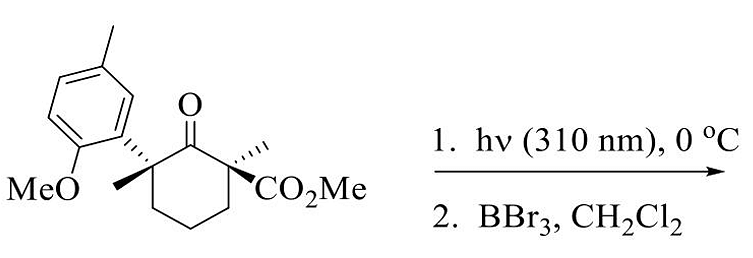
- The major product in the following reaction sequence is
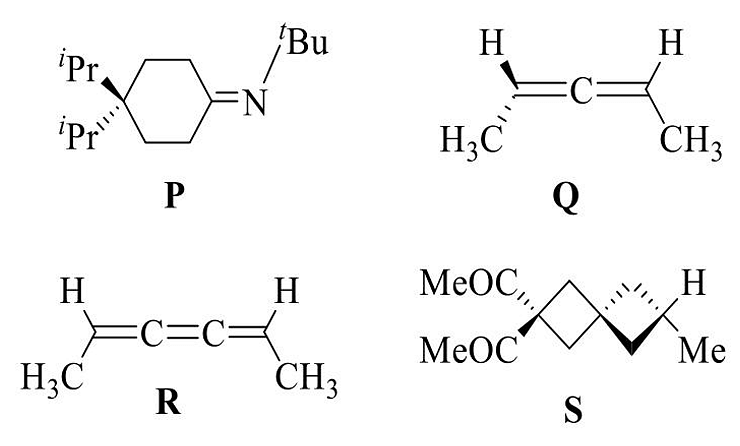
- Among the following, the chiral compound is
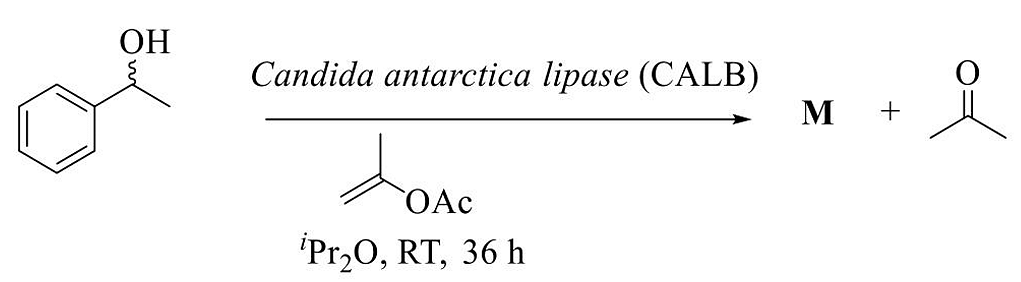
- The product M in the following reaction is
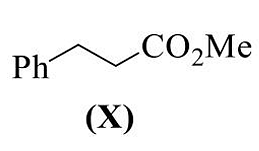
- The reaction(s) that yield(s) X as the major product is (are)
- The reaction(s) that yield(s) 2-methylquinoline as the major product is (are)
View More Questions
Top GATE CY Stereochemistry Questions
- The correct statement about the following quaternary ammonium ion is:

- In the \(^1\mathrm{H}\) NMR spectrum of compound \(\mathbf{X}\), the coupling constant (\(J_{ab}\)) between \(H_a\) and \(H_b\) is 3 Hz. The amino alcohol(s) that give(s) \(\mathbf{X}\) on reaction with methyl iodide followed by heating is(are)

- The difference in the number of gauche interactions present in diaxial and diequatorial chair conformations of trans-1,2-dimethylcyclohexane is (in integer).
Top GATE CY Questions
- Ψ(x) = \(\sqrt{\frac{32}{L^3}}\)[sin(\(\frac{\pi x}{L}\)).cos(\(\frac{\pi x}{L}\)).sin(\(\frac{2\pi y}{L}\)).sin(\(\frac{\pi z}{L}\))]Find the value of E221: E111.
 what is the final product
- Which are optically active?
 intensity ratio of final product
- Which among the following is true?
View More Questions