Question:
The difference in the number of gauche interactions present in diaxial and diequatorial chair conformations of trans-1,2-dimethylcyclohexane is (in integer).
The difference in the number of gauche interactions present in diaxial and diequatorial chair conformations of trans-1,2-dimethylcyclohexane is (in integer).
Show Hint
In a chair, 1,2-diaxial groups are anti to each other but each axial group has 2 extra gauche contacts with the ring; 1,2-diequatorial groups are gauche to each other but have no extra ring contacts.
Updated On: Aug 10, 2026
Show Solution

Verified By Collegedunia
Correct Answer: 3
Solution and Explanation
Step 1: Identify the two chair forms of trans-1,2-dimethylcyclohexane.
For a trans-1,2-disubstituted cyclohexane, one chair form puts both methyl groups equatorial (diequatorial), and ring flipping puts both methyl groups axial (diaxial). These are the two conformations asked about.
Step 2: Recall the 1,2-dihedral relationships in a chair.
Looking along any C1-C2 bond of a chair, adjacent axial substituents are anti to each other (\(180^{\circ}\) dihedral), while adjacent equatorial substituents are gauche to each other (\(60^{\circ}\) dihedral). Also, every axial substituent carries two extra gauche interactions with the axial hydrogens on the carbons two positions away (its 1,3-diaxial partners), while an equatorial substituent has none of these extra interactions.
Step 3: Count gauche interactions in the diaxial form.
Both methyls are axial, so the direct methyl-methyl (1,2) interaction is anti, contributing 0 gauche interactions. Each axial methyl separately has 2 gauche interactions with the ring (its 1,3-diaxial type contacts), so the two axial methyls give \(2+2=4\) gauche interactions in total.
Step 4: Count gauche interactions in the diequatorial form.
Both methyls are equatorial, so the direct methyl-methyl (1,2) interaction is gauche, contributing 1 gauche interaction. Equatorial substituents have no 1,3-diaxial type gauche interactions with the ring. So the diequatorial form has just 1 gauche interaction in total.
Step 5: Find the difference.
\[ \text{Difference} = 4 - 1 = 3 \]
Final Answer:
The diaxial form has 3 more gauche interactions than the diequatorial form. \[ \boxed{3} \]
For a trans-1,2-disubstituted cyclohexane, one chair form puts both methyl groups equatorial (diequatorial), and ring flipping puts both methyl groups axial (diaxial). These are the two conformations asked about.
Step 2: Recall the 1,2-dihedral relationships in a chair.
Looking along any C1-C2 bond of a chair, adjacent axial substituents are anti to each other (\(180^{\circ}\) dihedral), while adjacent equatorial substituents are gauche to each other (\(60^{\circ}\) dihedral). Also, every axial substituent carries two extra gauche interactions with the axial hydrogens on the carbons two positions away (its 1,3-diaxial partners), while an equatorial substituent has none of these extra interactions.
Step 3: Count gauche interactions in the diaxial form.
Both methyls are axial, so the direct methyl-methyl (1,2) interaction is anti, contributing 0 gauche interactions. Each axial methyl separately has 2 gauche interactions with the ring (its 1,3-diaxial type contacts), so the two axial methyls give \(2+2=4\) gauche interactions in total.
Step 4: Count gauche interactions in the diequatorial form.
Both methyls are equatorial, so the direct methyl-methyl (1,2) interaction is gauche, contributing 1 gauche interaction. Equatorial substituents have no 1,3-diaxial type gauche interactions with the ring. So the diequatorial form has just 1 gauche interaction in total.
Step 5: Find the difference.
\[ \text{Difference} = 4 - 1 = 3 \]
Final Answer:
The diaxial form has 3 more gauche interactions than the diequatorial form. \[ \boxed{3} \]
Was this answer helpful?
0
0
Top GATE CY Organic Chemistry Questions
- The major product in the following reaction sequence is
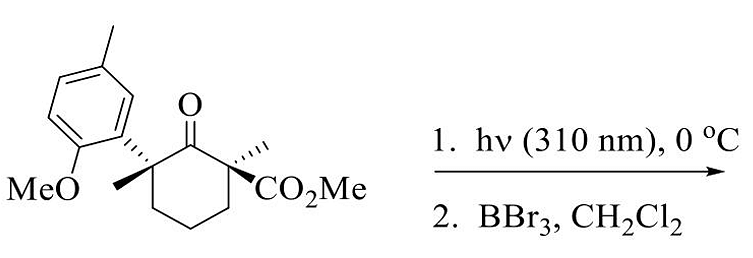
- Among the following, the chiral compound is
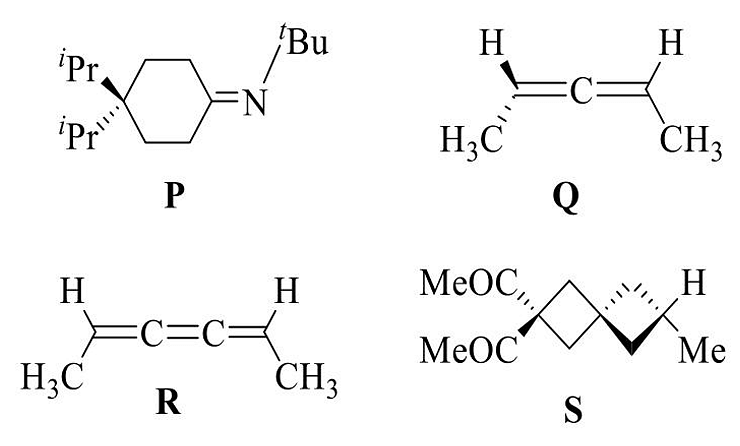
- The product M in the following reaction is
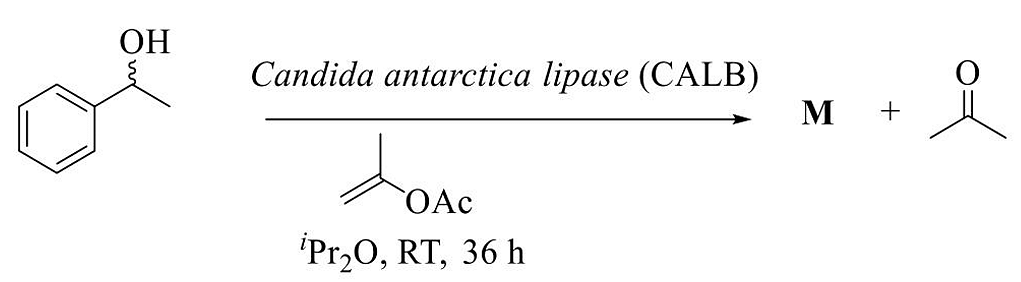
- The reaction(s) that yield(s) X as the major product is (are)
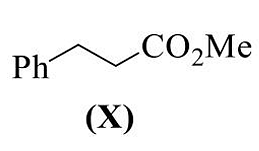
- The reaction(s) that yield(s) 2-methylquinoline as the major product is (are)
View More Questions
Top GATE CY Stereochemistry Questions
- The correct statement about the following quaternary ammonium ion is:

- The reaction(s) that give(s) meso-1,2-diphenylethane-1,2-diol as the major product is(are)
- In the \(^1\mathrm{H}\) NMR spectrum of compound \(\mathbf{X}\), the coupling constant (\(J_{ab}\)) between \(H_a\) and \(H_b\) is 3 Hz. The amino alcohol(s) that give(s) \(\mathbf{X}\) on reaction with methyl iodide followed by heating is(are)

Top GATE CY Questions
- Ψ(x) = \(\sqrt{\frac{32}{L^3}}\)[sin(\(\frac{\pi x}{L}\)).cos(\(\frac{\pi x}{L}\)).sin(\(\frac{2\pi y}{L}\)).sin(\(\frac{\pi z}{L}\))]Find the value of E221: E111.
 what is the final product
- Which are optically active?
 intensity ratio of final product
- Which among the following is true?
View More Questions