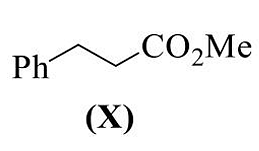
In the \(^1\mathrm{H}\) NMR spectrum of compound \(\mathbf{X}\), the coupling constant (\(J_{ab}\)) between \(H_a\) and \(H_b\) is 3 Hz. The amino alcohol(s) that give(s) \(\mathbf{X}\) on reaction with methyl iodide followed by heating is(are)
Show Hint
MeI quaternizes $NMe_2$; heating closes the ring by intramolecular $S_N2$ at the non-stereogenic $CH_2$ carbon, so the relative configuration of the two Ph-bearing centers is unchanged. Use the Karplus relation ($J$ small near $90^\circ$ dihedral) to pick the diastereomer, then include both its enantiomers.
Step 1: Understanding the Question.
Each amino alcohol has the skeleton \(Ar(CH_2NMe_2)-CH(Ph)-CH(Ph)-OH\), where the benzene ring carries an ortho \(CH_2NMe_2\) group and the side chain carries two adjacent stereocenters, each bearing a phenyl group. Treating this with excess methyl iodide first converts the tertiary amine \(NMe_2\) into a quaternary ammonium salt, \(CH_2\overset{+}{N}Me_3\, I^-\). On heating, the alcohol oxygen performs an intramolecular \(S_N2\) attack on that benzylic \(CH_2\) carbon, displacing neutral \(NMe_3\) as the leaving group and closing a six-membered ring, giving the cyclic benzo-fused ether \(\mathbf{X}\) (a 3,4-diphenylisochroman), with \(H_a\) and \(H_b\) as the two ring protons on the former stereocenters.
Step 2: The key mechanistic point, what stays the same and what changes.
The bond-forming step of the cyclization happens at the \(CH_2-NMe_3^+\) carbon, which is not a stereocenter (it only carries two hydrogens). The two real stereocenters, the ones bearing the phenyl groups, are never touched during this step. So the relative configuration between the two \(Ph\)-bearing centers in the starting amino alcohol (whether the two phenyls are disposed "like," i.e. \((R,R)/(S,S)\), or "unlike," i.e. \((R,S)/(S,R)\)) carries straight through unchanged into ring-closed product \(\mathbf{X}\).
Step 3: Use the coupling constant to fix the relative configuration in \(\mathbf{X}\).
Once the ring is closed, \(H_a\) and \(H_b\) sit on adjacent ring carbons in a rigid, benzo-fused six-membered ring, so their vicinal coupling constant \(J_{ab}\) is governed by the Karplus relation, which links \(J\) to the \(H-C-C-H\) dihedral angle: \(J\) is largest when the dihedral is near \(0^\circ\) or \(180^\circ\) (typically 8 to 12 Hz) and smallest when the dihedral is near \(90^\circ\) (close to 0 to 3 Hz). The observed small \(J_{ab} = 3\ \text{Hz}\) therefore corresponds to the diastereomer whose ring conformation places \(H_a\) and \(H_b\) close to a \(90^\circ\) dihedral, which is the relative configuration where the two phenyl groups are on the "unlike" disposition, forcing the two ring hydrogens into a near-perpendicular arrangement rather than the near-antiperiplanar arrangement of the other diastereomer (which would show a much larger \(J\), around 8 to 11 Hz).
Step 4: Match this back to the drawn amino alcohols and account for enantiomers.
A coupling constant depends only on the relative configuration between \(H_a\) and \(H_b\), not on which enantiomer is used, since enantiomers are mirror images with identical NMR spectra in an achiral environment. Among the four drawn amino alcohols, they form two enantiomeric pairs, one pair sharing the diastereomeric relationship required in Step 3, the other pair sharing the opposite one. Only the pair with the required "unlike" relative configuration reacts to give \(\mathbf{X}\) with \(J_{ab}=3\ \text{Hz}\); each member of that enantiomeric pair independently cyclizes (with retention of that relative configuration) to give racemic \(\mathbf{X}\) showing exactly the same, correct coupling constant. Structures B and C are that matching enantiomeric pair, while A and D are the enantiomeric pair of the other diastereomer, which would give a much larger \(J_{ab}\) and so are excluded.
Final Answer:
The amino alcohols that give \(\mathbf{X}\) with \(J_{ab}=3\ \text{Hz}\) are the enantiomeric pair (B) and (C).
\[ \boxed{\text{(B) and (C)}} \]



 what is the final product
 intensity ratio of final product