The correct statement about the following quaternary ammonium ion is:
Show Hint
Do not just count stereocenters, check for an improper symmetry element (\(\sigma\), \(i\), or \(S_n\)); an \(S_4\) axis alone, without a separate mirror plane or inversion center, is enough to make a molecule with several stereocenters achiral.
Step 1: Identify the stereocenters.
The cation is a pyrrolidinium ring in which all four ring carbons (\(C_2, C_3, C_4, C_5\), numbering around the ring from nitrogen) carry one methyl group and one hydrogen each. Each of these four ring carbons is bonded to four different groups, so all four are stereocenters. A molecule with several stereocenters is not automatically chiral, its overall symmetry decides that.
Step 2: Read the drawn relative configuration.
The wedge and hash bonds show the two methyls next to nitrogen (\(C_2\) and \(C_5\)) pointing to the same face of the ring, both wedge, "up", and the two methyls further from nitrogen (\(C_3\) and \(C_4\)) pointing to the opposite face, both hashed, "down". This is a specific, symmetric relative arrangement, not a random one.
Step 3: Look for a symmetry element, not just count stereocenters.
Chirality is decided by whether the molecule has an improper symmetry element, a mirror plane (\(\sigma\)), a center of inversion (\(i\)), or more generally an \(S_n\) improper rotation axis. A molecule that possesses any \(S_n\) axis (including the special cases \(S_1 = \sigma\) and \(S_2 = i\)) is achiral, even if it has several stereocenters and no simple mirror plane or inversion center on its own.
Here, rotating the ring by \(90^{\circ}\) about the axis running through \(\mathrm{N}\) and the midpoint of the \(C_3{-}C_4\) bond, followed by reflection through the plane perpendicular to that axis, exactly swaps the "up" methyl pair (\(C_2, C_5\)) with the "down" methyl pair (\(C_3, C_4\)) and maps the whole cation onto itself. This combined rotation-reflection is exactly the definition of an \(S_4\) axis.
Step 4: Conclude achirality from the \(S_4\) axis.
Since the molecule has an \(S_4\) axis, it is superimposable on its mirror image, so it is achiral, even though every individual ring carbon is a stereocenter. This is a standard example used to show that having stereocenters is not the same as being chiral, symmetry is what actually decides it.
Why the other options are wrong:
Option (A) is wrong because although a \(C_2\) axis is indeed present, through \(\mathrm{N}\) and the \(C_3{-}C_4\) midpoint, a proper rotation axis alone never causes achirality or chirality by itself, and the molecule additionally has the improper \(S_4\) axis, which makes it achiral, not chiral.
Option (C) is wrong because the molecule is not asymmetric, the paired "up-up-down-down" arrangement of the methyls is a deliberate symmetric pattern, not a random one.
Option (D) is wrong because the ring is not planar and the four substituents are not related through a single inversion center, the actual improper element present is the \(S_4\) axis, not a true center of symmetry \(i\).
Final Answer:
The ion has \(S_4\) symmetry and is therefore achiral.
\[ \boxed{\text{(B)}} \]


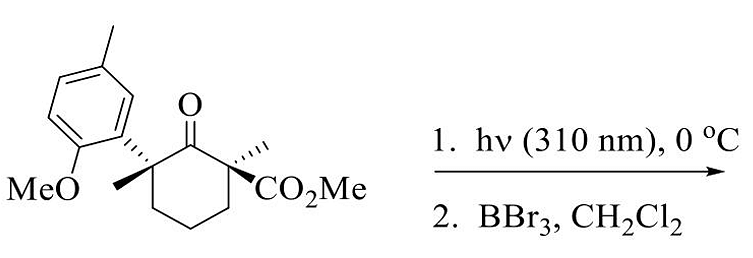
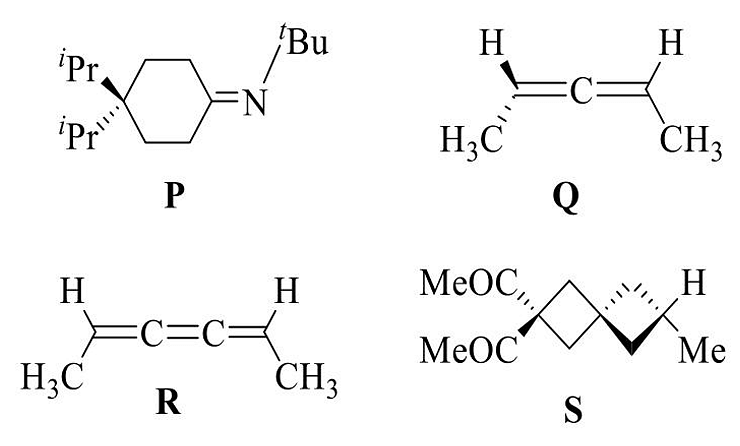
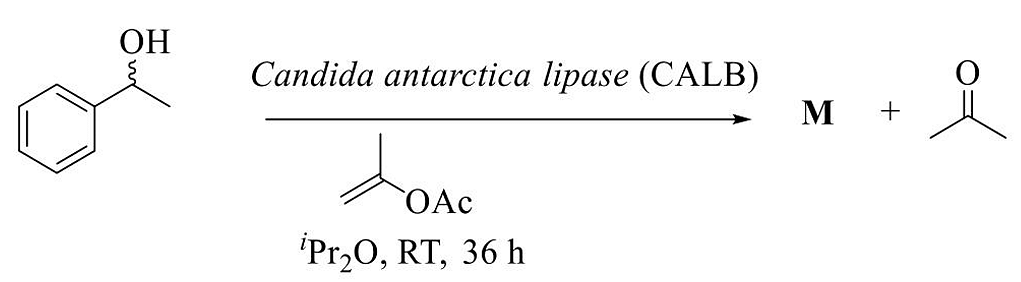
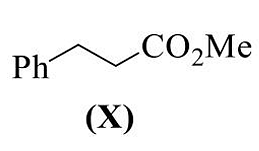

 what is the final product
 intensity ratio of final product