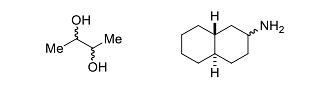
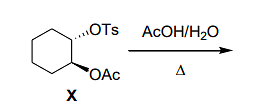
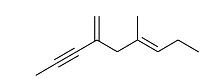
The molecules that possess $\sigma$ (plane of symmetry) as the ONLY element of symmetry are
Show Hint
For molecules having only $\sigma$ symmetry, check that the molecule has a mirror plane but no $C_n$ axis, centre of symmetry, or improper rotation axis
Step 1: Understand the requirement of the question.
The molecule should possess only one type of symmetry element, that is a plane of symmetry $\sigma$It should not possess other symmetry elements such as $C_n$ axis, centre of symmetry $i$, or improper axis $S_n$
Step 2: Analyze molecule I.
Molecule I is a substituted aromatic compoundThe benzene ring and the substituents lie in the same planeTherefore, the molecular plane itself acts as a plane of symmetry $\sigma$
Step 3: Check other symmetry elements in molecule I.
Due to the presence of two different substituents on the benzene ring, molecule I does not have a proper rotational axis $C_n$ or centre of symmetryThus, molecule I has only $\sigma$ as the symmetry element
Step 4: Analyze molecule II.
Molecule II is a substituted cyclopropane derivativeBecause of the arrangement of substituents on the cyclopropane ring, it does not have only a simple plane of symmetry as its sole symmetry elementHence, molecule II is not selected
Step 5: Analyze molecule III.
Molecule III is dimethyl sulfoxide, $(CH_3)_2SO$It has a plane of symmetry passing through the S=O bond and bisecting the two methyl groups
Step 6: Check other symmetry elements in molecule III.
The pyramidal nature around sulfur prevents the presence of higher rotational symmetry elementsTherefore, molecule III possesses $\sigma$ as the only symmetry element
Step 7: Analyze molecule IV and conclude.
Molecule IV is acetone, $(CH_3)_2CO$It has more than one symmetry element, including rotational symmetry and planes of symmetryTherefore, it does not satisfy the condition of having only $\sigma$ as the symmetry elementHence, the correct molecules are I and III
\[
\boxed{\text{I and III}}
\]