The angle of minimum deviation for a prism of apex angle 60° and refractive index of \(\sqrt{2}\) is:
The angle of minimum deviation for a prism of apex angle 60° and refractive index of \(\sqrt{2}\) is:
45°
90°
30°
60°
15°

The Correct Option is C
Approach Solution - 1
Given:
- Apex angle of prism, \( A = 60^\circ \)
- Refractive index, \( \mu = \sqrt{2} \)
Step 1: Formula for Minimum Deviation (\( \delta_{\text{min}} \))
The angle of minimum deviation is given by:
\[ \mu = \frac{\sin\left(\frac{A + \delta_{\text{min}}}{2}\right)}{\sin\left(\frac{A}{2}\right)} \]
Step 2: Substitute Known Values
\[ \sqrt{2} = \frac{\sin\left(\frac{60^\circ + \delta_{\text{min}}}{2}\right)}{\sin\left(30^\circ\right)} \]
Since \( \sin 30^\circ = 0.5 \):
\[ \sqrt{2} = \frac{\sin\left(30^\circ + \frac{\delta_{\text{min}}}{2}\right)}{0.5} \]
\[ \sin\left(30^\circ + \frac{\delta_{\text{min}}}{2}\right) = \frac{\sqrt{2}}{2} = \sin 45^\circ \]
Step 3: Solve for \( \delta_{\text{min}} \)
\[ 30^\circ + \frac{\delta_{\text{min}}}{2} = 45^\circ \]
\[ \frac{\delta_{\text{min}}}{2} = 15^\circ \]
\[ \delta_{\text{min}} = 30^\circ \]
Conclusion:
The angle of minimum deviation is \( 30^\circ \).
Answer: \(\boxed{C}\)
Approach Solution -2
1. Define variables and given information:
- A = 60° (apex angle of the prism)
- n = √2 (refractive index)
- δm = ? (angle of minimum deviation)
2. Recall the formula for the angle of minimum deviation:
The formula relating the angle of minimum deviation (δm), apex angle (A), and refractive index (n) is:
\[n = \frac{\sin(\frac{A + \delta_m}{2})}{\sin(\frac{A}{2})}\]
3. Substitute the given values and solve for δm:
\[\sqrt{2} = \frac{\sin(\frac{60^\circ + \delta_m}{2})}{\sin(\frac{60^\circ}{2})}\]
\[\sqrt{2} = \frac{\sin(\frac{60^\circ + \delta_m}{2})}{\sin(30^\circ)}\]
Since \(\sin(30^\circ) = \frac{1}{2}\):
\[\sqrt{2} = 2\sin(\frac{60^\circ + \delta_m}{2})\]
\[\frac{\sqrt{2}}{2} = \sin(\frac{60^\circ + \delta_m}{2})\]
\[\frac{1}{\sqrt{2}} = \sin(\frac{60^\circ + \delta_m}{2})\]
Since \(\sin(45^\circ) = \frac{1}{\sqrt{2}}\):
\[45^\circ = \frac{60^\circ + \delta_m}{2}\]
\[90^\circ = 60^\circ + \delta_m\]
\[\delta_m = 90^\circ - 60^\circ = 30^\circ\]
Top KEAM Physics Questions
- A body oscillates with SHM according to the equation (in SI units), $x = 5 cos \left(2\pi t +\frac{\pi}{4}\right) .$ Its instantaneous displacement at $t = 1$ second is
Kepler's second law (law of areas) of planetary motion leads to law of conservation of
- Two capillary tubes A and B of diameter $1\, mm$ and $2\, mm$ respectively are dipped vertically in a liquid. If the capillary rise in A is 6 cm, then the capillary rise in B is
- In the circuit given in figure, 1 and 2 are ammeters. Just after key K is pressed to complete the circuit, the reading will be
- A plate has a length $ 5\pm 0.1\text{ }cm $ and breadth $ 2\pm 0.01\text{ }cm $ . Then the area of the plate is:
Top KEAM Ray optics and optical instruments Questions
- Light travels in two media $A$ and $B$ with speeds $1.8 \times 10^8 ms^{-1}$ and $ 2.4 \times 10^8 ms^{-1}$ respectively. Then the critical angle between them is
- A vessel of depth $x$ is half filled with oil of refractive index $ {{\mu }_{1}} $ and the other half is filled with water of refractive index $ {{\mu }_{2}} $ The apparent depth of the vessel when viewed from above is
- An astronomical telescope has an angular magnification of magnitude $5$ for distant objects. The separation between the objective and the eye-piece is $36 \,cm$ and the final image is formed at infinity. The focal length $ {{f}_{o}} $ of the objective and $ {{f}_{e}} $ of the eye-piece are respectively
- In the measurement of the angle of a prism using a spectrometer, the readings of first reflected image are Vernier $I : 320^\circ 40';$ Vernier $ II : 140^\circ 30' $ and those of the second reflected image are Vernier $ I : 80^\circ 38'; $ Vernier $ II : 260^\circ 24'.$ Then the angle of the prism is
- The angle of minimum deviation in an equilateral prism of refractive index 1.414 is
Top KEAM Questions
- i.$\quad$ They help in respiration ii.$\quad$ They help in cell wall formation iii.$\quad$ They help in DNA replication iv. $\quad$They increase surface area of plasma membrane Which of the following prokaryotic structures has all the above roles?
- A body oscillates with SHM according to the equation (in SI units), $x = 5 cos \left(2\pi t +\frac{\pi}{4}\right) .$ Its instantaneous displacement at $t = 1$ second is
- The pH of a solution obtained by mixing 60 mL of 0.1 M BaOH solution at 40m of 0.15m HCI solution is
Kepler's second law (law of areas) of planetary motion leads to law of conservation of
- If $\int e^{2x}f' \left(x\right)dx =g \left(x\right)$, then $ \int\left(e^{2x}f\left(x\right) + e^{2x} f' \left(x\right)\right)dx =$
Concepts Used:
Prism
A homogeneous solid transparent and refracting medium bounded by 2 plane surfaces inclined at an angle called prism. The prism has two triangular faces that are parallel to each other and 3 rectangular surfaces. They are made from glass or other transparent material cut with accurate angles. Out of three, two rectangular faces are polished and are called refracting surfaces. The angle between these two rectangular faces is known as the refractive angle of the prism.
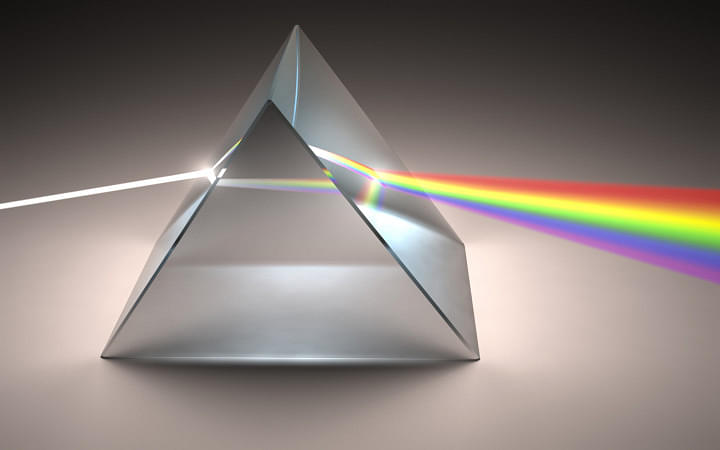
Depending on the application, prisms are made in different shapes. Triangle is the traditional shape of the prism. The triangular prism, when passed through the prism, separates the white light into constituent colors.
Five types of Prism are:
- Dispersive Prism
- Reflective Prism
- Polarizing Prism
- Beam-Splitting Prism
- Deflecting Prism