Question:
Partial hydrogenation of vegetable oils in the presence of Ni catalyst at 200°C gives:
Partial hydrogenation of vegetable oils in the presence of Ni catalyst at 200°C gives:
Updated On: Jul 14, 2026
- Butter
- Vanaspati ghee
- Cheese
- Margarine
Show Solution

Verified By Collegedunia
The Correct Option is D
Approach Solution - 1
The correct option is (D): Margarine.
Was this answer helpful?
0
0
Show Solution
Verified By Collegedunia
Approach Solution -2
Partial catalytic hydrogenation converts some of the unsaturated (cis) double bonds of liquid vegetable oils into saturated or trans bonds, raising the melting point enough to turn a liquid oil into a semi-solid fat. Each option can be checked against how it is actually manufactured:
- Butter: Butter is a natural dairy product churned from cream; it is not manufactured by chemically hydrogenating vegetable oil.
- Vanaspati ghee: Vanaspati is also produced by hydrogenating vegetable oil, but it is typically hydrogenated more extensively and blended with different additives to mimic the texture of ghee, rather than being the specific spreadable table-fat product obtained under the partial hydrogenation conditions described.
- Cheese: Cheese is made by curdling and fermenting milk; it has no relationship to the hydrogenation of vegetable oils.
- Margarine: Margarine is manufactured precisely by partially hydrogenating vegetable oils in the presence of a nickel catalyst at an elevated temperature, converting enough of the liquid oil's double bonds to give it a spreadable, semi-solid, butter-like consistency while leaving some unsaturation intact.
The process described, partial (not complete) hydrogenation with nickel catalyst at 200°C to obtain a spreadable semi-solid fat, corresponds to how margarine is industrially produced.
Therefore, the correct answer is Margarine.
Was this answer helpful?
0
0
Top GPAT Pharmacognosy Questions
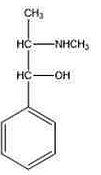
The above structure is of:- Which of the following materials are specified as a suitable diluent for powdered opium
A. Powdered grass
B. Powdered cocoa husk
C. Lactose colored with burnt sugar
D. Powdered digitalis
Choose the correct answer from the options given below: - HPTLC analysis is useful for following types of analysis of herbal drugs
A. Quantitative estimation of marker compound
B. Authentication of extracts
C. Detection of pesticides
D. Standardization of herbal drugs
Choose the correct answer from the options given below: - Anthranilic acid is an immediate precursor in the formation of
- Tropane nucleus is combination of
View More Questions
Top GPAT Extraction and Isolation Techniques Questions
Top GPAT Questions
- Match the symbols in the List I with the terms used in the List II of conductance measurements, and
List I
SymbolsList II
TermsA \(\Omega^{-1}\) I Specific conductance B \(∧\) II Electrical conductance C k III Specific resistance D \(\rho\) IV Equivalent conductance
Choose the correct answer from the options given below: - Cottrell’s method is used for the measurement of:
- Match the statements in List I with their correct answers in List II, respectively, in respect to modified 1st law of thermodynamics, and
List I
List II
A Constant heat (q = 0) I Isothermal B Reversible process at constant temperature (dT = 0) II Isometric C Constant volume (dV = 0) III Adiabatic D Constant pressure (dP = 0) IV Isobar
Choose the correct answer from the options given below: - Boric acid with molecular weight 61.83 was partitioned between water and amyl alcohol at 25 °C. The amount of boric acid was determined to be 0.24 g in 250 ml of amyl alcohol and 0.32 g in 100 ml water. The partition coefficient of boric acid between water and amyl alcohol, when calculated at molar concentration for each of the solution, is:
- Drugs ‘A’, ‘B’ and ‘C’ follow zero order, first order and second order degradation kinetics, respectively, but have the same rate constant. Which of the following statement is true in this respect:
View More Questions