Question:
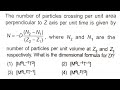
Number of particles passing in unit time through unit area perpendicular to the z-axis is given by:
$N = D \dfrac{(N_2 - N_1)}{(Z_2 - Z_1)}$,
where $N_2$ and $N_1$ are the number of particles in unit volume at $Z_2$ and $Z_1$. The dimensional formula of $D$ is?
Number of particles passing in unit time through unit area perpendicular to the z-axis is given by:
$N = D \dfrac{(N_2 - N_1)}{(Z_2 - Z_1)}$,
where $N_2$ and $N_1$ are the number of particles in unit volume at $Z_2$ and $Z_1$. The dimensional formula of $D$ is?
$N = D \dfrac{(N_2 - N_1)}{(Z_2 - Z_1)}$,
where $N_2$ and $N_1$ are the number of particles in unit volume at $Z_2$ and $Z_1$. The dimensional formula of $D$ is?
Updated On: Apr 10, 2025
- (A) M0L-2T2
- (B) M0L-1T-1
- (C) M0L2T-1
- (D) M0L-2T-2
Show Solution

Verified By Collegedunia
The Correct Option is C
Approach Solution - 1
Explanation:
Dimensional formula for number of particles per unit area per unit time is and are the number of the particles in unit volume. Dimensional formula for is Dimensional formula for and is Therefore, dimensional formula for
Dimensional formula for number of particles per unit area per unit time is and are the number of the particles in unit volume. Dimensional formula for is Dimensional formula for and is Therefore, dimensional formula for
Was this answer helpful?
1
0
Show Solution
Verified By Collegedunia
Approach Solution -2
Principle of Homegeinity
According to the Principle of Homogeneity, the dimensions of each term in a dimensional equation on both sides should be the same.
To check the correctness of a given equation using dimensional analysis, we should apply the homogeneity principle to the equation.
For example, the given physical equation is
Kinetic energy, E = 1/2 mv2
Where m is the mass and v is the velocity.
The above equation will be dimensionally correct if the dimensions of the right side of the equation are the same as that of the left side of the equation.
Limitations of Dimensional Analysis
The limitations of dimensional analysis are
- Dimensionless constant involved in the physical relation cannot be determined.
- The dimensional method fails to derive the relation like
S = ut + 1/2 at2 and v2 - u2 = 2aS
- It fails to give information about trigonometric functions, logarithmic, exponential, and complex quantities.
- A dimensionally correct relation may not be true physical relation.
Was this answer helpful?
0
0
Learn with videos:
Top WBJEE Physics Questions
- The velocity of a particle executing a simple harmonic motion is $13\, ms^{-1}$, when its distance from the equilibrium position (Q) is 3 m and its velocity is $12 \, ms^{-1}$, when it is 5 m away from The frequency of the simple harmonic motion is
- A and B are two parallel sided transparent slabs of refractive indices n$_1 $and n$_2$ respectively. A ray is incident at an angle $\theta$ on the surface of separation of A and B, and after refraction from B into air grazes the surface of B. Then
- The minimum and maximum capacitances, which may be obtained by the combination of three capacitors each of capacitance 6$\mu$ F are
- The increase in electrostatic potential energy of a dipole of moment p when it is taken from parallel to anti-parallel orientation in an electric field E is
- A zener diode has break down voltage of 5.0 V. The resistance required to allow a current of 100 mA through the zener in reverse bias when connected to a battery of emf 12 V is
View More Questions
Top WBJEE Electric charges and fields Questions
- Four charges equal to $-Q$ are placed at the four corners of a square and a charge $q$ is at its centre. lf the system is in equilibrium, the value of $q$ is
- An infinite sheet carrying a uniform surface charge density o lies on the $x y$-plane. The work done to carry a charge $q$ from the point $A =a(\hat{ i }+2 \hat{ j }+3 \hat{ k })$ to the point $B =a(\hat{ i }-2 \hat{ j }+6 \hat{ k })$ (where $a$ is a constant with the dimension of length and $\varepsilon_{0}$ is the permittivity of free space) is
- A positive charge $Q$ is situated at the centre of a cube. The electric flux through any face of the cube is (in $SI$ units)
Top WBJEE Questions
- Let $\vec{\alpha } = \hat{i} + \hat{j} + \hat{k} , \vec{\beta} = \hat{i} - \hat{j} - \hat{k}$ and $\vec{\gamma} = - \hat{i} + \hat{j} - \hat{k}$ be three vectors. A vector $\vec{\delta} $, in the plane of $\vec{\alpha}$ and $\vec{\beta}$, whose projection on $\vec{\gamma}$ is $\frac{1}{\sqrt{3}}$, is given by
- Let a, b, c be real numbers such that $a + b + c < 0$ and the quadratic equation $ax^2 + bx + c = 0$ has imaginary roots. Then
- If the radius of a spherical balloon increases by 0.1%, then its volume increases approximately by
- The velocity of a particle executing a simple harmonic motion is $13\, ms^{-1}$, when its distance from the equilibrium position (Q) is 3 m and its velocity is $12 \, ms^{-1}$, when it is 5 m away from The frequency of the simple harmonic motion is
- By which of the following methods, new and better varieties of plants can be formed?
View More Questions