Let A=$\begin{bmatrix}
1 & 3 & 2 \\
2 & 5 &t \\
4&7-t&-6 \\ \end{bmatrix}$, then the values of t for which inverse of A does not exist
- -2, 1
- 44622
- 2, -3
- 3, -1

The Correct Option is C
Solution and Explanation
The inverse of a matrix does not exist when its determinant is zero.
So,
\(\begin{vmatrix} 1 & 3 & 2 \\ 2 & 5 & t \\ 4 & 7-t & -6 \end{vmatrix} = 0\)
Expanding along the first row:
\((1)\begin{vmatrix}5 & t \\ 7-t & -6\end{vmatrix} - 3\begin{vmatrix}2 & t \\ 4 & -6\end{vmatrix} + 2\begin{vmatrix}2 & 5 \\ 4 & 7-t\end{vmatrix} = 0\)
Now compute minors:
\(1[(5)(-6) - t(7-t)] - 3[(2)(-6) - 4t] + 2[(2)(7-t) - 20] = 0\)
Simplifying:
\((-30 - 7t + t^2) - 3(-12 - 4t) + 2(14 - 2t - 20) = 0\)
\(-30 - 7t + t^2 + 36 + 12t - 12 - 4t = 0\)
\(t^2 + t - 6 = 0\)
Factorising:
\((t+3)(t-2)=0\)
Hence,
\(t = 2 \text{ or } -3\)
Top VITEEE Mathematics Questions
- The product of all values of $(\cos \alpha + i \sin \alpha)^{3/5}$ is equal to
- A football is inflated by pumping air in it. When it acquires spherical shape its radius increases at the rate of 0.02 cm/s. The rate of increase of its volume when the radius is 10 cm is ___________$\pi$ cm/s
- The interval in which the function $f\left(x\right) = \frac{4x^{2}+1}{x}$ is decreasing is :
- If the normal to the curve $y = f(x)$ at $(3,4)$ makes an angle $\frac{3 \pi}{4}$ with the positive x-axis, then $f'(3)$ is equal to
- The principal value of $sin^{-1} \left(sin \frac{5\pi}{3}\right)$ is
Top VITEEE Questions
- A motor of power $P_0$ is used to deliver water at a certain rate through a given horizontal pipe. To increase the rate of flow of water through the same pipe $n$ times, the power of the motor is increased to $P_1$. The ratio of $P_1 $ to $P_0$ is
- A $30\,V-90\,W$ lamp is operated on a $120\,V$ DC line. A resistor is connected in series with the lamp in order to glow it properly. The value of resistance is
- Which of the following is not a characteristic of transition elements ?
- Most crystals show good cleavage because their atoms, ions or molecules are
- Which of the following sets consists only of essential amino acids ?
Concepts Used:
Invertible matrices
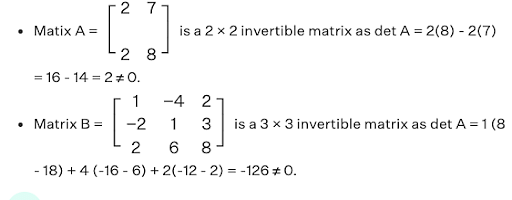
A matrix for which matrix inversion operation exists, given that it satisfies the requisite conditions is known as an invertible matrix. Any given square matrix A of order n × n is called invertible if and only if there exists, another n × n square matrix B such that, AB = BA = In, where In is an identity matrix of order n × n.
For example,
It can be observed that the determinant of the following matrices is non-zero.