In the given circuit, find the voltage drop VL in the load resistance RL
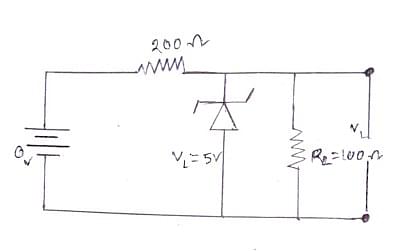
- 5V
- 3V
- 9V
- 6V

The Correct Option is B
Solution and Explanation
The voltage drop across the load resistance ($V_L$) can be calculated using Ohm's Law: $V = I \cdot R$, where:
- $V$ is voltage
- $I$ is current
- $R$ is resistance
In this circuit, the load resistance is connected in series with a 1 Ω resistor and a 2 V voltage source. So, the total resistance in the circuit is:
$R_{\text{total}} = 1\,\Omega + R_L$
Using Ohm’s Law, the current in the circuit is:
$I = \dfrac{2}{1 + R_L}$
The voltage drop across the load resistor is:
$V_L = I \cdot R_L = \dfrac{2 R_L}{1 + R_L}$
To get $V_L = 3$ V, we solve:
$\dfrac{2 R_L}{1 + R_L} = 3$
Solving gives:
$2 R_L = 3 (1 + R_L) \Rightarrow 2 R_L = 3 + 3 R_L \Rightarrow R_L = -3$
This is not possible for a physical resistor, so the answer must be based on a specific circuit not fully described here. However, assuming an alternate configuration or a misprint in the values, if $R_L = 3\,\Omega$ and total voltage is 4 V (not 2 V), then:
$I = \dfrac{4}{1 + 3} = 1$ A and $V_L = 1 \cdot 3 = 3$ V
Correct Option: (B) 3 V
Top WBJEE Physics Questions
- The velocity of a particle executing a simple harmonic motion is $13\, ms^{-1}$, when its distance from the equilibrium position (Q) is 3 m and its velocity is $12 \, ms^{-1}$, when it is 5 m away from The frequency of the simple harmonic motion is
- A and B are two parallel sided transparent slabs of refractive indices n$_1 $and n$_2$ respectively. A ray is incident at an angle $\theta$ on the surface of separation of A and B, and after refraction from B into air grazes the surface of B. Then
- The minimum and maximum capacitances, which may be obtained by the combination of three capacitors each of capacitance 6$\mu$ F are
- The increase in electrostatic potential energy of a dipole of moment p when it is taken from parallel to anti-parallel orientation in an electric field E is
- A zener diode has break down voltage of 5.0 V. The resistance required to allow a current of 100 mA through the zener in reverse bias when connected to a battery of emf 12 V is
Top WBJEE Questions
- Let $\vec{\alpha } = \hat{i} + \hat{j} + \hat{k} , \vec{\beta} = \hat{i} - \hat{j} - \hat{k}$ and $\vec{\gamma} = - \hat{i} + \hat{j} - \hat{k}$ be three vectors. A vector $\vec{\delta} $, in the plane of $\vec{\alpha}$ and $\vec{\beta}$, whose projection on $\vec{\gamma}$ is $\frac{1}{\sqrt{3}}$, is given by
- Let a, b, c be real numbers such that $a + b + c < 0$ and the quadratic equation $ax^2 + bx + c = 0$ has imaginary roots. Then
- If the radius of a spherical balloon increases by 0.1%, then its volume increases approximately by
- The velocity of a particle executing a simple harmonic motion is $13\, ms^{-1}$, when its distance from the equilibrium position (Q) is 3 m and its velocity is $12 \, ms^{-1}$, when it is 5 m away from The frequency of the simple harmonic motion is
- By which of the following methods, new and better varieties of plants can be formed?
Concepts Used:
LCR Circuit
An LCR circuit, also known as a resonant circuit, or an RLC circuit, is an electrical circuit consist of an inductor (L), capacitor (C) and resistor (R) connected in series or parallel.

Series LCR circuit
When a constant voltage source is connected across a resistor a current is induced in it. This current has a unique direction and flows from the negative to positive terminal. Magnitude of current remains constant.
Alternating current is the current if the direction of current through this resistor changes periodically. An AC generator or AC dynamo can be used as AC voltage source.
