Question:
In a single-slit diffraction experiment, the slit is illuminated by light of two wavelengths \(\lambda_1\) and \(\lambda_2\). It is observed that the 2nd order diffraction minimum for \(\lambda_1\) coincides with the 3rd diffraction minimum for \(\lambda_2\). Then:
In a single-slit diffraction experiment, the slit is illuminated by light of two wavelengths \(\lambda_1\) and \(\lambda_2\). It is observed that the 2nd order diffraction minimum for \(\lambda_1\) coincides with the 3rd diffraction minimum for \(\lambda_2\). Then:
Show Hint
In diffraction problems, use the diffraction condition equation and compare the angles for different orders to relate the wavelengths involved.
Updated On: Jan 29, 2026
- \(\frac{\lambda_1}{\lambda_2} = \frac{2}{3}\)
- \(\frac{\lambda_1}{\lambda_2} = \frac{5}{7}\)
- \(\frac{\lambda_1}{\lambda_2} = \frac{3}{2}\)
- \(\frac{\lambda_1}{\lambda_2} = \frac{7}{5}\)
Show Solution

Verified By Collegedunia
The Correct Option is C
Solution and Explanation
Step 1: In single-slit diffraction, the condition for the \( m \)-th diffraction minimum is given by:
\[ a \sin \theta_m = m\lambda, \]
where \( a \) is the width of the slit, \( \lambda \) is the wavelength of light, and \( m \) is the diffraction order.
Step 2: For the 2nd order minimum of \( \lambda_1 \) and the 3rd order minimum of \( \lambda_2 \), we can set the angle for both minima equal since they coincide:
\[ 2\lambda_1 = 3\lambda_2 \]
Thus:
\[ \frac{\lambda_1}{\lambda_2} = \frac{3}{2}. \]
Was this answer helpful?
0
0
Top WBJEE Physics Questions
- The velocity of a particle executing a simple harmonic motion is $13\, ms^{-1}$, when its distance from the equilibrium position (Q) is 3 m and its velocity is $12 \, ms^{-1}$, when it is 5 m away from The frequency of the simple harmonic motion is
- A and B are two parallel sided transparent slabs of refractive indices n$_1 $and n$_2$ respectively. A ray is incident at an angle $\theta$ on the surface of separation of A and B, and after refraction from B into air grazes the surface of B. Then
- The minimum and maximum capacitances, which may be obtained by the combination of three capacitors each of capacitance 6$\mu$ F are
- The increase in electrostatic potential energy of a dipole of moment p when it is taken from parallel to anti-parallel orientation in an electric field E is
- A zener diode has break down voltage of 5.0 V. The resistance required to allow a current of 100 mA through the zener in reverse bias when connected to a battery of emf 12 V is
View More Questions
Top WBJEE Wave optics Questions
- In Young�s double slit experiment, the fringe width is $\beta$. If the entire arrangement is placed in a liquid of refractive index $n$, the fringe width becomes :
- If Young?s double slit experiment is done with white light, which of the following statements will be true ?
- Three identical thin bar magnets, each of moment M, are placed along three adjacent sides of a regular hexagon as shown in the figure. The resultant magnetic moment of the system is

- X-rays of wavelength λ get reflected from parallel planes of atoms in a crystal with spacing d between two planes as shown in the figure. If the two reflected beams interfare constructively,Then the condition for maxima will be(n is the order of interference fringe)
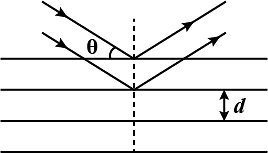
- Light of wavelength \(6000 \, \text{Å}\) is incident on a thin glass plate of refractive index \(1.5\) such that the angle of refraction into the plate is \(60^\circ\). Calculate the smallest thickness of the plate which will make a dark fringe by reflected beam interference.
View More Questions
Top WBJEE Questions
- Let $\vec{\alpha } = \hat{i} + \hat{j} + \hat{k} , \vec{\beta} = \hat{i} - \hat{j} - \hat{k}$ and $\vec{\gamma} = - \hat{i} + \hat{j} - \hat{k}$ be three vectors. A vector $\vec{\delta} $, in the plane of $\vec{\alpha}$ and $\vec{\beta}$, whose projection on $\vec{\gamma}$ is $\frac{1}{\sqrt{3}}$, is given by
- Let a, b, c be real numbers such that $a + b + c < 0$ and the quadratic equation $ax^2 + bx + c = 0$ has imaginary roots. Then
- If the radius of a spherical balloon increases by 0.1%, then its volume increases approximately by
- The velocity of a particle executing a simple harmonic motion is $13\, ms^{-1}$, when its distance from the equilibrium position (Q) is 3 m and its velocity is $12 \, ms^{-1}$, when it is 5 m away from The frequency of the simple harmonic motion is
- By which of the following methods, new and better varieties of plants can be formed?
View More Questions