Question:
Child presents with myoclonus jerk, decrease performance in school. There is history of fever at the age of 1 year with rash. It is suggestive of-
Child presents with myoclonus jerk, decrease performance in school. There is history of fever at the age of 1 year with rash. It is suggestive of-
Show Hint
Think about which progressive CNS disease is linked to measles infection in infancy after a long latent period.
Updated On: Jun 23, 2026
- Subacute sclerosing panencephalitis
- Mesial temporal sclerosis
- Polio
- Measles
Show Solution

Verified By Collegedunia
The Correct Option is A
Solution and Explanation
Step 1: Identify the key clinical features.
The child has myoclonic jerks, declining school performance (cognitive deterioration), and a prior history of fever with rash at 1 year of age -- highly suggestive of measles infection in early childhood.
Step 2: Pathophysiology of SSPE.
Subacute Sclerosing Panencephalitis (SSPE) is a progressive, fatal neurological disorder caused by a persistent defective measles virus that remains latent in CNS neurons. It typically appears 6-8 years after the initial measles infection, especially when measles occurred before age 2.
Step 3: Stages of SSPE.
Stage I -- Subtle behavioural changes, memory loss, poor school performance. Stage II -- Involuntary myoclonic jerks (periodic, stereotyped), seizures; EEG shows Radermecker complexes. Stage III -- Rigidity, decerebrate posturing. Stage IV -- Coma and death.
Step 4: Eliminate distractors.
Mesial temporal sclerosis causes temporal lobe epilepsy but not myoclonic jerks post-measles. Polio causes flaccid paralysis without cognitive decline. Measles itself is an acute illness and does not present years later with this picture. SSPE is the only entity linking early measles to a latent progressive CNS disease with myoclonus.
The child has myoclonic jerks, declining school performance (cognitive deterioration), and a prior history of fever with rash at 1 year of age -- highly suggestive of measles infection in early childhood.
Step 2: Pathophysiology of SSPE.
Subacute Sclerosing Panencephalitis (SSPE) is a progressive, fatal neurological disorder caused by a persistent defective measles virus that remains latent in CNS neurons. It typically appears 6-8 years after the initial measles infection, especially when measles occurred before age 2.
Step 3: Stages of SSPE.
Stage I -- Subtle behavioural changes, memory loss, poor school performance. Stage II -- Involuntary myoclonic jerks (periodic, stereotyped), seizures; EEG shows Radermecker complexes. Stage III -- Rigidity, decerebrate posturing. Stage IV -- Coma and death.
Step 4: Eliminate distractors.
Mesial temporal sclerosis causes temporal lobe epilepsy but not myoclonic jerks post-measles. Polio causes flaccid paralysis without cognitive decline. Measles itself is an acute illness and does not present years later with this picture. SSPE is the only entity linking early measles to a latent progressive CNS disease with myoclonus.
Was this answer helpful?
0
0
Top NEET PG Pediatrics Questions
- A newborn presented with chest retractions, dyspnea, and lethargy. The pediatrician diagnosed the baby with respiratory distress syndrome. This occurs due to the deficiency of:
- A 10-year-old child weighing 30 kg presents with a history of loose stools for 2 days. On examination, there is severe dehydration. Laboratory investigations are as follows. What is the initial management as per ISPAD guidelines?
RBS 550mg/dL pH 7.01 Na+ 158mEq/L Urine glucose 3+
- Which of the following is the best sign to indicate adequate growth in an infant with a birth weight of 2.8 kg?
- A 3-month-old baby complains of deafness, cataract, and patent ductus arteriosus. Which of the following is the most likely diagnosis?
Chloride level in sweat is used in the diagnosis of which disease?
View More Questions
Top NEET PG Pediatric Disorders Questions
- A newborn presented with chest retractions, dyspnea, and lethargy. The pediatrician diagnosed the baby with respiratory distress syndrome. This occurs due to the deficiency of:
Chloride level in sweat is used in the diagnosis of which disease?
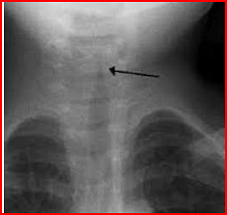
- A child is brought to the hospital with respiratory distress and biphasic stridor. The radiograph is shown below. What is the diagnosis?
- A 3-month-old baby presents with jaundice and clay-coloured stools. Lab investigation reveals that the baby has conjugated hyperbilirubinemia. The liver biopsy shows periductal proliferation. What is the most likely diagnosis?
- A child demonstrates progressive neurological decline and a cherry-red spot on fundus examination. Enzyme analysis reveals a deficiency in hexosaminidase A. What is the most likely diagnosis?
View More Questions
Top NEET PG Questions
- A patient hailing from Delhi presents with fever, arthralgia, and extensive petechial rash for 3 days. Lab investigations revealed a hemoglobin of 9 g/ dL, a white blood cell count of 9000 cells/mm3, a platelet count of 20000 cells/mm3, and a prolonged bleeding time. The clotting time was normal. What is the most likely diagnosis?
- Which of the following statements is true about Trichomonas vaginalis?
- A lady from West Rajasthan presented with an ulcer surrounded by erythema on the right leg. Microscopy of the biopsy from the edge of the ulcer showed organisms with dark staining nuclei and kinetoplast. What is the most likely causative agent?
- A child presents with a fever and a rash. Urine examination showed cells with owl's eye appearance. What is the most likely diagnosis?
- Infection with Clonorchis sinensis is associated with an increased risk of__?
View More Questions