Question:
A child is brought to the hospital with respiratory distress and biphasic stridor. The radiograph is shown below. What is the diagnosis?
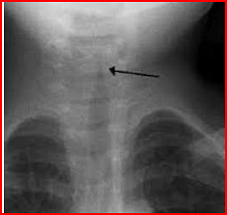
A child is brought to the hospital with respiratory distress and biphasic stridor. The radiograph is shown below. What is the diagnosis?
Updated On: Jun 19, 2025
Acute epiglottitis
- Acute laryngotracheobronchitis
Foreign body aspiration
- Laryngomalacia
Show Solution

Verified By Collegedunia
The Correct Option is B
Solution and Explanation
The child presenting with respiratory distress and biphasic stridor suggests an upper airway obstruction. The radiograph may exhibit characteristic features associated with these symptoms. Here is an analysis of the given options:
- Acute epiglottitis: Typically presents with high fever, drooling, and difficulty swallowing. Radiographs show the classic "thumb sign" due to an enlarged epiglottis.
- Acute laryngotracheobronchitis (Croup): Commonly seen in children, characterized by a barking cough and stridor. Radiographs show the "steeple sign" due to subglottic narrowing.
- Foreign body aspiration: Can cause sudden respiratory distress and localized wheezing. Radiographic findings vary based on the object's location and type.
- Laryngomalacia: Typically affects infants with intermittent stridor, worsening in supine positions. It's a structural condition, usually not seen on x-rays.
The symptoms of respiratory distress and biphasic stridor, coupled with radiographic findings of subglottic narrowing (not visible here but suggested), point towards Acute laryngotracheobronchitis as the diagnosis.
Was this answer helpful?
0
0
Top NEET PG Pediatrics Questions
- A newborn presented with chest retractions, dyspnea, and lethargy. The pediatrician diagnosed the baby with respiratory distress syndrome. This occurs due to the deficiency of:
- A 10-year-old child weighing 30 kg presents with a history of loose stools for 2 days. On examination, there is severe dehydration. Laboratory investigations are as follows. What is the initial management as per ISPAD guidelines?
RBS 550mg/dL pH 7.01 Na+ 158mEq/L Urine glucose 3+
- Which of the following is the best sign to indicate adequate growth in an infant with a birth weight of 2.8 kg?
- A 3-month-old baby complains of deafness, cataract, and patent ductus arteriosus. Which of the following is the most likely diagnosis?
Chloride level in sweat is used in the diagnosis of which disease?
View More Questions
Top NEET PG Pediatric Disorders Questions
- A newborn presented with chest retractions, dyspnea, and lethargy. The pediatrician diagnosed the baby with respiratory distress syndrome. This occurs due to the deficiency of:
Chloride level in sweat is used in the diagnosis of which disease?
- A 3-month-old baby presents with jaundice and clay-coloured stools. Lab investigation reveals that the baby has conjugated hyperbilirubinemia. The liver biopsy shows periductal proliferation. What is the most likely diagnosis?
Top NEET PG Questions
- A patient hailing from Delhi presents with fever, arthralgia, and extensive petechial rash for 3 days. Lab investigations revealed a hemoglobin of 9 g/ dL, a white blood cell count of 9000 cells/mm3, a platelet count of 20000 cells/mm3, and a prolonged bleeding time. The clotting time was normal. What is the most likely diagnosis?
- Which of the following statements is true about Trichomonas vaginalis?
- A lady from West Rajasthan presented with an ulcer surrounded by erythema on the right leg. Microscopy of the biopsy from the edge of the ulcer showed organisms with dark staining nuclei and kinetoplast. What is the most likely causative agent?
- A child presents with a fever and a rash. Urine examination showed cells with owl's eye appearance. What is the most likely diagnosis?
- Infection with Clonorchis sinensis is associated with an increased risk of__?
View More Questions