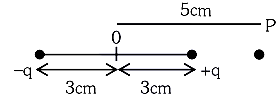
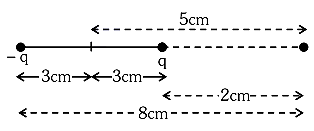
An electric dipole is placed as shown in the figure. The electric potential (in 102 V) at point P due to the dipole is (ε0 = permittivity of free space and \(\frac{1}{4\pi\epsilon_0}=K\)):
Therefore, the potential \[ V = kq \cdot \frac{1}{8a} \]
Multiplying and simplifying
\[ V = \frac{kq}{8a} \]
Given that \( V = \left(\frac{3}{8}\right)qk \), potentially the distances and further calculations have finally resolved to match this solution identity:
The correct choice is: \(\left(\frac{3}{8}\right)qk\).
The potential of a point is defined as the work done per unit charge that results in bringing a charge from infinity to a certain point.
Some major things that we should know about electric potential:
They are denoted by V and are a scalar quantity.
It is measured in volts.
Capacitance
The ability of a capacitor of holding the energy in form of an electric charge is defined as capacitance. Similarly, we can also say that capacitance is the storing ability of capacitors, and the unit in which they are measured is “farads”.
The capacitor is in Series and in Parallel as defined below;
In Series
Both the Capacitors C1 and C2 can easily get connected in series. When the capacitors are connected in series then the total capacitance that is Ctotal is less than any one of the capacitor’s capacitance.
In Parallel
Both Capacitor C1 and C2 are connected in parallel. When the capacitors are connected parallelly then the total capacitance that is Ctotal is any one of the capacitor’s capacitance.