1980 V
660 V
1320 V
1520 V
Let's solve the problem step-by-step to find the potential of the bigger drop formed by combining 27 identical drops, each charged at 220 V.
Step 1: Calculate the charge on one small drop
The potential \( V \) of a drop is given by the formula:
\(V = \frac{k \cdot q}{r}\)
where \( k \) is Coulomb's constant, \( q \) is the charge on the drop, and \( r \) is the radius of the drop.
Rearranging, we find the charge \( q \) on one drop:
\(q = \frac{V \cdot r}{k}\)
Since all 27 drops are identical, each has the same charge \( q \).
Step 2: Combine the charges
When the drops combine to form a bigger drop, their total charge \( Q \) is the sum of the charges of the 27 smaller drops:
\(Q = 27 \cdot q\)
Step 3: Relate the volumes of the drops
Since volume is proportional to the cube of the radius, we have:
\(27 \cdot \frac{4}{3}\pi r^3 = \frac{4}{3}\pi R^3\)
where \( R \) is the radius of the bigger drop.
This implies:
\(R = 3r\)
Step 4: Calculate the potential of the bigger drop
The potential \( V' \) of the bigger drop is given by:
\(V' = \frac{k \cdot Q}{R}\)
Substituting \( Q = 27q \) and \( R = 3r \):
\(V' = \frac{k \cdot 27q}{3r} = 9 \cdot \frac{k \cdot q}{r} = 9V\)
Since each small drop has a potential of \( 220 \, \text{V} \):
\(V' = 9 \cdot 220 = 1980 \, \text{V}\)
Thus, the potential of the bigger drop is 1980 V.
The correct answer is therefore \(1980 V\).
Two charges \( +q \) and \( -q \) are placed at points \( A \) and \( B \) respectively which are at a distance \( 2L \) apart. \( C \) is the midpoint of \( AB \). The work done in moving a charge \( +Q \) along the semicircle CSD (\( W_1 \)) and along the line CBD (\( W_2 \)) are 
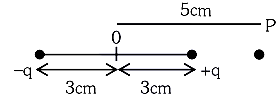
Find work done in bringing charge q = 3nC from infinity to point A as shown in the figure : 
Given below are two statements:
Statement I: Transfer RNAs and ribosomal RNA do not interact with mRNA.
Statement II: RNA interference (RNAi) takes place in all eukaryotic organisms as a method of cellular defence.
In the light of the above statements, choose the most appropriate answer from the options given below:
Electrostatics is the branch of physics that deals with the study of stationary electric charges and their interactions. It involves the study of electric fields, electric charges, electric potential, and electric potential energy.
Electric charges are either positive or negative, and like charges repel while opposite charges attract. Electric charges can be generated by the transfer of electrons from one material to another, by contact between charged objects, or by induction, which involves the creation of an electric field that causes a separation of charges in a conductor.
Electric fields are regions in space around a charged object where an electric force is exerted on other charged objects. The strength of the electric field depends on the distance from the charged object and the magnitude of the charge.
Electric potential is a measure of the work required to move a unit charge from one point to another in an electric field. Electric potential energy is the energy that a charged object possesses due to its position in an electric field.
The behavior of electric charges and fields is described by Coulomb's law, which states that the force between two point charges is proportional to the product of their charges and inversely proportional to the square of the distance between them.
Electrostatics has numerous applications in technology, including in the design of electrical and electronic devices, such as capacitors and semiconductors. It also plays a vital role in everyday life, such as in the generation and distribution of electric power and in the functioning of the human nervous system.