Question:
According to the law of equipartition of energy, the number of vibrational modes of a polyatomic gas of constant \(\gamma = \frac{C_P}{C_V}\) is (\(C_P\) where \(C_V\) are the specific heat capacities of the gas at constant pressure and constant volume, respectively):
According to the law of equipartition of energy, the number of vibrational modes of a polyatomic gas of constant \(\gamma = \frac{C_P}{C_V}\) is (\(C_P\) where \(C_V\) are the specific heat capacities of the gas at constant pressure and constant volume, respectively):
Updated On: Apr 14, 2026
- $\frac{4 + 3\gamma}{\gamma - 1}$
$\frac{3 + 4\gamma}{\gamma -1}$
$\frac{4 - 3\gamma}{\gamma -1}$
- $\frac{3 - 4\gamma}{\gamma - 1}$
Show Solution

Verified By Collegedunia
The Correct Option is C
Solution and Explanation
For a polyatomic gas with 3 translational, 3 rotational, and $f$ vibrational modes:
Internal energy (U) $= \frac{3}{2}k_BT + \frac{3}{2}k_BT + fk_BT = (3 + f)k_BT$
$C_v = (3 + f)R$
$C_p = (4 + f)R$
$\gamma = \frac{C_p}{C_v} = \frac{4 + f}{3 + f}$
$3\gamma + f\gamma = 4 + f$
$f(\gamma - 1) = 4 - 3\gamma$
$f = \frac{4 - 3\gamma}{\gamma - 1}$
Was this answer helpful?
0
0
Top NEET Physics Questions
- A coil of inductive reactance $31\, \Omega$ has a resistance of 8 $\Omega$. It is placed in series with a condenser of capacitative reactance $25 \,\Omega$. The combination is connected to an a.c. source of 110 V. The power factor of the circuit is :-
- A car starts from rest and accelerates at $5\, m / s ^{2}$ At $t=4\, s$, a ball is dropped out of a window by a person sitting in the car. What is the velocity and acceleration of the ball at $t =6\, s$ ? (Take $\left. g =10\, m / s ^{2}\right)$
- In an a.c. circuit with phase voltage V and current I, the power dissipated is
- A bubble in glass slab $ (\mu = 1.5) $ when viewed from one side appears at 5 cm and 2 cm from other side, then thickness of slab is
- A bulb is located on a wall. Its image is to be obtained on a parallel wall with the help of convex lens. If the distance between parallel walls is 'd' then required focal length of lens placed in between the walls is : -
View More Questions
Top NEET Thermodynamics Questions
- A monoatomic gas at a pressure P, having a volume V expands isothermally to a volume 2V and then adiabatically to a volume 16V. The final pressure of the gas is: (take γ = 5/3)
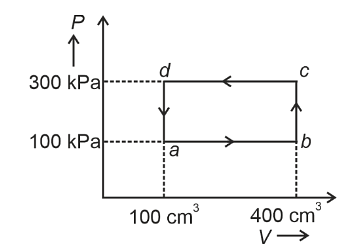
- A thermodynamic system is taken through the cycle abcda. The work done by the gas along the path bc is :
- Water is used as a coolant in a nuclear reactor because of its
- The value of electric potential at a distance of 9 cm from the point charge \(4 \times 10^{-7} \, \text{C}\) is
\[ \text{Given} \, \frac{1}{4 \pi \epsilon_0} = 9 \times 10^9 \, \text{N m}^2 \text{C}^{-2} \] - Two gases A and B are filled at the same pressure in separate cylinders with movable pistons of radii \(r_A\) and \(r_B\) respectively. On supplying an equal amount of heat to both the cylinders, their pressures remain constant and their pistons are displaced by 16 cm and 9 cm respectively. If the change in their internal energies is the same, then the ratio \(r_A / r_B\) is:
Top NEET Questions
- In spite of interspecific competition in nature, which mechanism the competing species might have evolved for their survival?
- A coil of inductive reactance $31\, \Omega$ has a resistance of 8 $\Omega$. It is placed in series with a condenser of capacitative reactance $25 \,\Omega$. The combination is connected to an a.c. source of 110 V. The power factor of the circuit is :-
- A car starts from rest and accelerates at $5\, m / s ^{2}$ At $t=4\, s$, a ball is dropped out of a window by a person sitting in the car. What is the velocity and acceleration of the ball at $t =6\, s$ ? (Take $\left. g =10\, m / s ^{2}\right)$
- A liquid compound (x) can be purified by steam distillation only if it is
- In an a.c. circuit with phase voltage V and current I, the power dissipated is
View More Questions