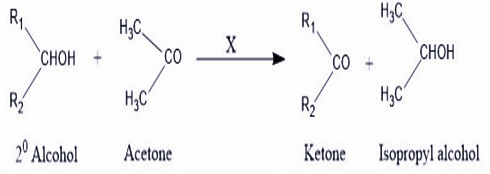
According to Oppenauer Oxidation reaction, oxidation of secondary alcohol to ketone by reagent (X) in acetone takes place, what is "X" :
Show Hint
The Oppenauer oxidation uses Aluminium t-butoxide as a reagent to selectively oxidize secondary alcohols to ketones. It is a mild oxidation method that avoids overoxidation.
In the Oppenauer Oxidation reaction, the reagent Aluminium t-butoxide is used to oxidize secondary alcohols to ketones in acetone. This reaction typically involves the selective oxidation of secondary alcohols while maintaining the stability of other functional groups.
Was this answer helpful?
1
0
Show Solution
Verified By Collegedunia
Approach Solution -2
The Oppenauer oxidation is a named reaction that converts secondary alcohols to ketones using a metal alkoxide catalyst together with a hydrogen-accepting ketone solvent such as acetone. Checking what role each listed reagent could play in this reaction identifies X.
Aluminium Hydroxide: Aluminium hydroxide is a mild, amphoteric base commonly used as an antacid or in adjuvants; it has no alkoxide ligands to transfer a hydride and cannot carry out the hydride shift needed for this oxidation.
Amalgamated Zinc and Conc. HCl: This reagent combination is used for the Clemmensen reduction, which reduces a ketone all the way down to a methylene group, the reverse type of transformation from an alcohol to ketone oxidation, so it does not fit here.
Conc. \(H_2SO_4\): Concentrated sulfuric acid is a strong dehydrating and protonating acid, useful for reactions like esterification or dehydration, but it does not perform the specific hydride transfer mechanism that defines the Oppenauer oxidation.
Aluminium t-butoxide: In the Oppenauer oxidation, aluminium t-butoxide coordinates to the oxygen of the secondary alcohol, then a hydride is transferred intramolecularly from the alcohol's carbon onto the carbonyl carbon of acetone (the hydrogen acceptor), forming the ketone product from the alcohol and reducing acetone to isopropanol in the process. This aluminium alkoxide is the specific catalyst that gives the reaction its name.
Only aluminium t-butoxide can coordinate the alcohol and mediate the hydride shift to acetone that defines this named reaction.
Therefore, the correct answer is Aluminium t-butoxide.