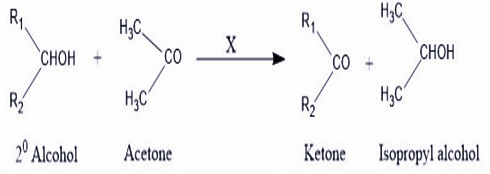
The Oppenauer oxidation converts a secondary alcohol to a ketone using acetone as the hydrogen acceptor, and the question asks which reagent drives that hydride transfer. Let's examine each option against how this specific named reaction actually works.
Aluminium Hydroxide: Aluminium hydroxide, \(\text{Al(OH)}_3\), is a simple base and mild amphoteric compound. It does not form the alkoxide-metal complex needed to shuttle a hydride from the alcohol to acetone, so it cannot drive this specific oxidation.
Amalgamated Zinc & Conc. HCl: This reagent pair is used in Clemmensen reduction, which reduces a ketone or aldehyde to a methylene group, the opposite direction of reaction from what Oppenauer oxidation carries out. It has no role in oxidizing an alcohol to a ketone.
Conc. \(H_2SO_4\): Concentrated sulfuric acid is a strong acid catalyst used in reactions like esterification or dehydration, not in a hydride-transfer oxidation. It does not fit the Oppenauer mechanism, which needs a metal alkoxide, not a strong Bronsted acid.
Aluminium t-butoxide: Aluminium tert-butoxide is the classic catalyst for Oppenauer oxidation. The alcohol first exchanges with the alkoxide to form an aluminium alkoxide of the substrate, then a six-membered cyclic transition state transfers a hydride from the alcohol's carbon directly to the carbonyl carbon of acetone, oxidizing the alcohol to a ketone while acetone is reduced to isopropanol.
Since only aluminium tert-butoxide can form the alkoxide intermediate and mediate the hydride shift to acetone that defines this reaction, it is the reagent (X) used here.