ABC is an isosceles triangle with an inscribed circle with center O. Let P be the midpoint of BC. If AB=AC=15 and BC=10,then OP equals
- \(\frac{\sqrt5}{\sqrt2}\) unit
\(\frac{5}{\sqrt2}\) unit
- \(\frac{2}{\sqrt5}\) unit
- \(5\sqrt2\) unit

The Correct Option is B
Solution and Explanation
Given:
Isosceles triangle ABC with AB = AC = 15 and BC = 10.
O is the center of the inscribed circle.
P is the midpoint of BC.
We want to find the length of OP.
Step 1: Draw a diagram.
Draw isosceles triangle ABC with AB = AC = 15 and BC = 10. Draw the inscribed circle with center O. Since ABC is isosceles, the altitude from A to BC will bisect BC at point P. Thus, AP is the altitude and median to BC. Also, O will lie on AP. OP is the radius (r) of the inscribed circle.
Step 2: Find the length of AP.
Triangle ABP is a right-angled triangle with AB = 15 and BP = BC/2 = 10/2 = 5.
Using the Pythagorean theorem:
\(AP^2 + BP^2 = AB^2\)
\(AP^2 + 5^2 = 15^2\)
\(AP^2 + 25 = 225\)
\(AP^2 = 200\)
\(AP = \sqrt{200} = 10\sqrt{2}\)
Step 3: Find the semi-perimeter (s) of triangle ABC.
\(s = \frac{AB + AC + BC}{2} = \frac{15 + 15 + 10}{2} = \frac{40}{2} = 20\)
Step 4: Find the area of triangle ABC.
\(Area = \frac{1}{2} \cdot BC \cdot AP = \frac{1}{2} \cdot 10 \cdot 10\sqrt{2} = 50\sqrt{2}\)
Step 5: Find the inradius (r) of the inscribed circle.
The area of a triangle can also be expressed as \(Area = r \cdot s\), where r is the inradius and s is the semi-perimeter.
\(r = \frac{Area}{s} = \frac{50\sqrt{2}}{20} = \frac{5\sqrt{2}}{2}\)
Since OP is the radius of the inscribed circle, OP = r.
\(OP = \frac{5\sqrt{2}}{2} = \frac{5}{\sqrt{2}}\)
Therefore, OP = \(\frac{5}{\sqrt{2}}\) units.
Top WBJEE Mathematics Questions
- Let $\vec{\alpha } = \hat{i} + \hat{j} + \hat{k} , \vec{\beta} = \hat{i} - \hat{j} - \hat{k}$ and $\vec{\gamma} = - \hat{i} + \hat{j} - \hat{k}$ be three vectors. A vector $\vec{\delta} $, in the plane of $\vec{\alpha}$ and $\vec{\beta}$, whose projection on $\vec{\gamma}$ is $\frac{1}{\sqrt{3}}$, is given by
- Let a, b, c be real numbers such that $a + b + c < 0$ and the quadratic equation $ax^2 + bx + c = 0$ has imaginary roots. Then
- If the radius of a spherical balloon increases by 0.1%, then its volume increases approximately by
- If $\theta + \phi = \frac{\pi}{4}$, then $\left(1+ \tan\,?\right)\left(1+ \tan\,\phi\right)$ is equal to
- $\frac {3x^2+1}{x^2-6x+8}$ is equal to
Top WBJEE Three Dimensional Geometry Questions
Top WBJEE Questions
- Let $\vec{\alpha } = \hat{i} + \hat{j} + \hat{k} , \vec{\beta} = \hat{i} - \hat{j} - \hat{k}$ and $\vec{\gamma} = - \hat{i} + \hat{j} - \hat{k}$ be three vectors. A vector $\vec{\delta} $, in the plane of $\vec{\alpha}$ and $\vec{\beta}$, whose projection on $\vec{\gamma}$ is $\frac{1}{\sqrt{3}}$, is given by
- Let a, b, c be real numbers such that $a + b + c < 0$ and the quadratic equation $ax^2 + bx + c = 0$ has imaginary roots. Then
- If the radius of a spherical balloon increases by 0.1%, then its volume increases approximately by
- The velocity of a particle executing a simple harmonic motion is $13\, ms^{-1}$, when its distance from the equilibrium position (Q) is 3 m and its velocity is $12 \, ms^{-1}$, when it is 5 m away from The frequency of the simple harmonic motion is
- By which of the following methods, new and better varieties of plants can be formed?
Concepts Used:
Three Dimensional Geometry
Mathematically, Geometry is one of the most important topics. The concepts of Geometry are derived w.r.t. the planes. So, Geometry is divided into three major categories based on its dimensions which are one-dimensional geometry, two-dimensional geometry, and three-dimensional geometry.
Direction Cosines and Direction Ratios of Line:
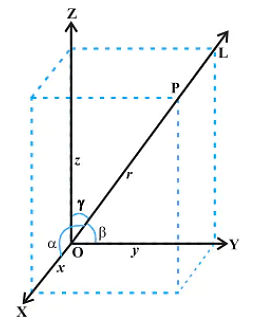
Consider a line L that is passing through the three-dimensional plane. Now, x,y and z are the axes of the plane and α,β, and γ are the three angles the line makes with these axes. These are commonly known as the direction angles of the plane. So, appropriately, we can say that cosα, cosβ, and cosγ are the direction cosines of the given line L.