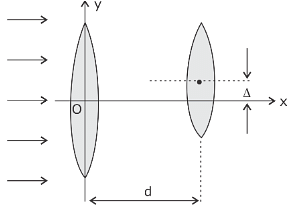
A thin convex lens L (refractive index = 1.5) is placed on a plane mirror M. When a pin is placed at A, such that OA = 18 cm, its real inverted image is formed at A itself, as shown in figure. When a liquid of refractive index \(\mu_1\) is put between the lens and the mirror, The pin has to be moved to A', such that OA' = 27 cm, to get its inverted real image at A' itself. The value of \(\mu_1\) will be :-
Show Hint
The image coincides with the pin only if the rays leave the lens parallel and strike the mirror normally, so the pin sits at the focus of the lens system. The liquid forms a plano-concave lens in contact with the convex lens.
Without liquid: the image forms at the pin only when the rays become parallel after the lens and fall normally on the mirror. So the pin is at the focus: \(f_L=18\) cm. For the equiconvex lens: \(\dfrac{1}{f_L}=(1.5-1)\left(\dfrac{2}{R}\right)=\dfrac{1}{R}\) \(\Rightarrow\) R = 18 cm. With liquid: the liquid between the lens and the plane mirror forms a plano-concave lens (curved face of radius R = 18 cm, other face plane): \(\dfrac{1}{f_{liq}}=(\mu_1-1)\left(\dfrac{1}{-R}-\dfrac{1}{\infty}\right)=-\dfrac{\mu_1-1}{18}\). The lens + liquid combination has focal length 27 cm (pin at A' = 27 cm): \(\dfrac{1}{27}=\dfrac{1}{18}-\dfrac{\mu_1-1}{18}\). \(\mu_1-1=1-\dfrac{18}{27}=\dfrac13\) \(\Rightarrow\) \(\mu_1=\dfrac43\). Answer: (4) \(4/3\)