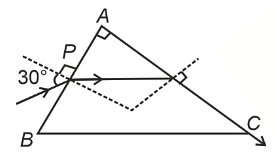
A ray of monochromatic light is passing through an equilateral prism (ABC) as shown in the figure. The refracted ray (QR) is parallel to its base (BC) and the angle of incidence (i) is 50°. Then the angle of deviation ($\delta$) is: ____.
Show Hint
The phrase "parallel to the base" is a major hint. It mathematically implies symmetry ($i=e$ and $r_1=r_2$), which greatly simplifies prism problems.
Step 1: Understanding the Concept:
When a refracted ray inside a prism is parallel to the base, the prism is in the condition of minimum deviation. In this state, the angle of incidence ($i$) is equal to the angle of emergence ($e$). Step 2: Key Formula or Approach:
For a prism:
\[ \delta = i + e - A \]
Where $A$ is the angle of the prism. Step 3: Detailed Explanation:
1. Identify Angle A: Since it is an equilateral prism, $A = 60^\circ$.
2. Condition of Symmetry: Because the refracted ray is parallel to the base, $i = e$.
3. Given $i = 50^\circ$, therefore $e = 50^\circ$.
4. Calculate Deviation ($\delta$):
\[ \delta = 50^\circ + 50^\circ - 60^\circ \]
\[ \delta = 100^\circ - 60^\circ = 40^\circ \] Step 4: Final Answer:
The angle of deviation is 40°.