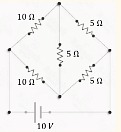
A heater is designed to operate with a power of 1000 W in a 100 V line. It is connected in combination with a resistance of 10 \(\Omega\) and a resistance \(R\), to a 100 V mains as shown in the figure. For the heater to operate at 62.5 W, the value of \(R\) should be \(\dots\) \(\Omega\).
To determine the value of \( R \) for the heater to operate at 62.5 W, we start by analyzing the circuit. The heater is in parallel with the resistance \( R \), and together they are in series with the 10 \(\Omega\) resistor.
Step 1: Determine the current in the heater when operating at 62.5 W:
The power \( P \) is given by \( P = \frac{V_h^2}{R_h} \), where \( V_h \) is the voltage across the heater. Since the heater's power is 62.5 W, we set:
\( 62.5 = \frac{V_h^2}{R_h} \).
The heater's original power when 100 V is applied is 1000 W, so:
Step 2: Use voltage across heater to find total current and then resistance \( R \):
The voltage across the parallel combination (heater and \( R \)) is 25 V. This means the remainder of the voltage in the loop must be across the 10 \(\Omega\) resistor. The total circuit voltage is 100 V, so the voltage across the 10 \(\Omega\) resistor is:
\( 100 - 25 = 75\ V \).
The current through the 10 \(\Omega\) resistor is thus:
\( I = \frac{75}{10} = 7.5\ A \).
Step 3: Calculate the resistance \( R \):
The current through the heater, \( i_h \), is:
\( P = V \times I \) → \( 62.5 = 25 \times i_h \) → \( i_h = 2.5\ A \).
The current \( i_h \) is also the current through \( R \). From the total current \( 7.5\ A \), the current remaining for the parallel branch is
\( i_R = 7.5 - 2.5 = 5\ A \).
The voltage across \( R \) is 25 V (same as across the heater), so:
\( R = \frac{V}{i_R} = \frac{25}{5} = 5\ \Omega \).
Conclusion: The resistance \( R \) is 5 \(\Omega\). This value lies within the specified range (5,5), confirming the solution is correct.
Was this answer helpful?
0
0
Show Solution
Verified By Collegedunia
Approach Solution -2
The resistance of the heater is: \[ R_{\text{heater}} = \frac{V^2}{P} = \frac{(100)^2}{1000} = 10 \, \Omega. \] For the heater operating at \(P = 62.5 \, \text{W}\), the voltage across the heater is: \[ P = \frac{V^2}{R} \implies V = \sqrt{PR}. \] Substitute \(P = 62.5 \, \text{W}\) and \(R = 10 \, \Omega\): \[ V = \sqrt{62.5 \times 10} = 25 \, \text{V}. \] In the circuit, the voltage drop across the \(10 \, \Omega\) resistor is: \[ V_R = 100 - 25 = 75 \, \text{V}. \] The current through the \(10 \, \Omega\) resistor is: \[ i_1 = \frac{V_R}{R} = \frac{75}{10} = 7.5 \, \text{A}. \] The current through the heater is: \[ i_H = \frac{V}{R} = \frac{25}{10} = 2.5 \, \text{A}. \] The current through \(R\) is: \[ i_R = i_1 - i_H = 7.5 - 2.5 = 5 \, \text{A}. \] Using Ohm’s law for \(R\): \[ V = i_R R \implies R = \frac{V}{i_R}. \] Substitute \(V = 25 \, \text{V}\) and \(i_R = 5 \, \text{A}\): \[ R = \frac{25}{5} = 5 \, \Omega. \] Thus, the value of \(R\) is: \[ R = 5 \, \Omega. \]