A capacitor has capacitance $5 \mu F$ when it's parallel plates are separated by air medium of thickness d A slab of material of dielectric constant $15$ having area equal to that of plates but thickness $\frac{d}{2}$ is inserted between the plates Capacitance of the capacitor in the presence of slab will be ___$\mu F$

Correct Answer: 6
Solution and Explanation
The correct answer is 6.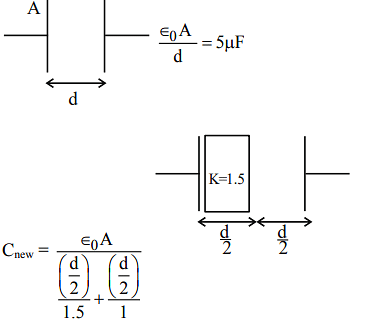
Top JEE Main Physics Questions
- Two masses $m$ and $\frac{m}{2}$ are connected at the two ends of a massless rigid rod of length $l$. The rod is suspended by a thin wire of torsional constant $k$ at the centre of mass of the rod-mass system(see figure). Because of torsional constant $k$, the restoring torque is $\tau =k\theta$ for angular displacement $\theta$. If the rod is rota ted by $\theta_0$ and released, the tension in it when it passes through its mean position will be:
A black body is at a temperature of 2880 K. The energy of radiation emitted by this body with wavelength between 499 nm and 500 nm is U1, between 999 nm and 1000 nm is U2 and between 1499 nm and 1500 nm is U3. The Wien's constant, b = 2.88×10⁶ nm-K. Then,
- $I _{ CM }$ is the moment of inertia of a circular disc about an axis (CM) passing through its center and perpendicular to the plane of disc $I_{A B}$ is it's moment of inertia about an axis $AB$ perpendicular to plane and parallel to axis $CM$ at a distance $\frac{2}{3} R$ from center Where $R$ is the radius of the dise The ratio of $I _{ AB }$ and $I _{ CM }$ is $x: 9$ The value of $x$ is______

- A nucleus disintegrates into two smaller parts, which have their velocities in the ratio $3: 2$ The ratio of their nuclear sizes will be $\left(\frac{x}{3}\right)^{\frac{1}{3}}$ The value of ' $x$ ' is:-
- A particle starts with an initial velocity of 10.0 m/s along x-direction and accelerates uniformly at the rate of 2.0 m/s$^2$. The time taken by the particle to reach the velocity of 60.0 m/s is
Top JEE Main electrostatic potential and capacitance Questions
An electric charge \(10^{-6} \, \mu C\) is placed at the origin (0, 0) of an X-Y coordinate system. Two points P and Q are situated at \((\sqrt{3}, \sqrt{3}) \, \text{mm}\) and \((\sqrt{6}, 0) \, \text{mm}\) respectively. The potential difference between the points P and Q will be:
- Three infinitely long wires with linear charge density \( \lambda \) are placed along the x-axis, y-axis and z-axis respectively. Which of the following denotes an equipotential surface?
Two capacitors \( C_1 \) and \( C_2 \) are connected in parallel to a battery. Charge-time graph is shown below for the two capacitors. The energy stored with them are \( U_1 \) and \( U_2 \), respectively. Which of the given statements is true?

- A wire of resistance R is bent into an equilateral triangle and an identical wire is bent into a square. The ratio of resistance between the two end points of an edge of the triangle to that of the square is:
Given below are two statements: one is labelled as Assertion (A) and the other is labelled as Reason (R).
Assertion (A): Choke coil is simply a coil having a large inductance but a small resistance. Choke coils are used with fluorescent mercury-tube fittings. If household electric power is directly connected to a mercury tube, the tube will be damaged.
Reason (R): By using the choke coil, the voltage across the tube is reduced by a factor \( \frac{R}{\sqrt{R^2 + \omega^2 L^2}} \), where \( \omega \) is the frequency of the supply across resistor \( R \) and inductor \( L \). If the choke coil were not used, the voltage across the resistor would be the same as the applied voltage.
In light of the above statements, choose the most appropriate answer from the options given below:
Top JEE Main Questions
- Two masses $m$ and $\frac{m}{2}$ are connected at the two ends of a massless rigid rod of length $l$. The rod is suspended by a thin wire of torsional constant $k$ at the centre of mass of the rod-mass system(see figure). Because of torsional constant $k$, the restoring torque is $\tau =k\theta$ for angular displacement $\theta$. If the rod is rota ted by $\theta_0$ and released, the tension in it when it passes through its mean position will be:
What will be the equilibrium constant of the given reaction carried out in a \(5 \,L\) vessel and having equilibrium amounts of \(A_2\) and \(A\) as \(0.5\) mole and \(2 \times 10^{-6}\) mole respectively?
The reaction : \(A_2 \rightleftharpoons 2A\)- The value of is
- The number of terms of an is even. The sum of the odd terms is and of the even terms is . The last term exceeds the first by . Then the number of terms in the series is ______.
A black body is at a temperature of 2880 K. The energy of radiation emitted by this body with wavelength between 499 nm and 500 nm is U1, between 999 nm and 1000 nm is U2 and between 1499 nm and 1500 nm is U3. The Wien's constant, b = 2.88×10⁶ nm-K. Then,
Concepts Used:
Electrostatic Potential and Capacitance
Electrostatic Potential
The potential of a point is defined as the work done per unit charge that results in bringing a charge from infinity to a certain point.
Some major things that we should know about electric potential:
- They are denoted by V and are a scalar quantity.
- It is measured in volts.
Capacitance
The ability of a capacitor of holding the energy in form of an electric charge is defined as capacitance. Similarly, we can also say that capacitance is the storing ability of capacitors, and the unit in which they are measured is “farads”.
Read More: Electrostatic Potential and Capacitance
The capacitor is in Series and in Parallel as defined below;
In Series
Both the Capacitors C1 and C2 can easily get connected in series. When the capacitors are connected in series then the total capacitance that is Ctotal is less than any one of the capacitor’s capacitance.
In Parallel
Both Capacitor C1 and C2 are connected in parallel. When the capacitors are connected parallelly then the total capacitance that is Ctotal is any one of the capacitor’s capacitance.