If the two metals $A$ and $B$ are exposed to radiation of wavelength $350 mm$. The work functions of metals $A$ and $B$ are $4.8 eV$ and $2.2 eV$. Then choose the correct option
A hypothetical gas expands adiabatically such that its volume changes from 08 litres to 27 litres. If the ratio of final pressure of the gas to initial pressure of the gas is $\frac{16}{B 1}$. Then the ratio of $\frac{C p}{C v}$ will be
A small object at rest, absorbs a light pulse of power $20 \,mW$ and duration $300\, ns$. Assuming speed of light as $3 \times 10^8 \,m / s$, the momentum of the object becomes equal to :
Electron beam used in an electron microscope, when accelerated by a voltage of $20 kV$, has a de-Broglie wavelength of $\lambda_0$. If the voltage is increased to $40 kV$, then the de-Broglie wavelength associated with the electron beam would be:
Two objects \(A\) and \(B\)are placed at \(15\, cm\) and \(25\, cm\) from the pole in front of a concave mirros having radius of curvature \(40\, cm\). The distance between images formed by the mirror is:
As shown in figure, a $70 kg$ garden roller is pushed with a force of $\vec{F}=200 N$ at an angle of $30^{\circ}$ with horizontal. The normal reaction on the roller is (Given $g=10 m s ^{-2}$ )
Choose the correct options based on the column shown below.
If frequency can be represented as f = (radius)a (density)b (surface tension)c. Find a, b, c?
When a parallel beam of white light incident on convex lens split into different colours the phenomenon is called.
Two isolated metallic solid spheres of radii $R$ and $2 R$ are charged such that both have same charge density $\sigma$. The spheres are then connected by a thin conducting wire. If the new charge density of the bigger sphere is $\sigma^{\prime}$ The ratio $\frac{\sigma^{\prime}}{\sigma}$ is :
Given below are two statements: Statement I : Acceleration due to earth's gravity decreases as you go 'up' or 'down' from earth's surface Statement II : Acceleration due to earth's gravity is same at a height '\(h\)' and depth ' \(d\) ' from earth's surface, if \(h = d\).In the light of above statements, Choose the most appropriate answer form the options given below
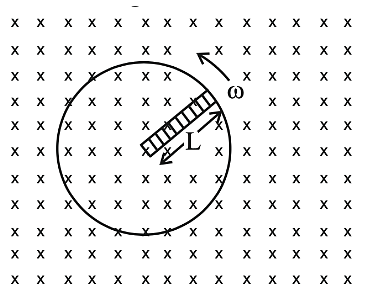
A metallic rod of length ' \(L\) ' is rotated with an angular speed of ' \(\omega\) ' normal to a uniform magnetic field ' \(B\) ' about an axis passing through one end of rod as shown in figure. The induced emf will be :