Determine the amount of urea (NH2CONH2) to be added in 1000 g of water to decrease its vapour pressure by 25%.
2[Au(CN)2]– + Zn \(\to\) [Zn(CN)4]2– + 2Au\(\downarrow\) is which of these (A) Redox reaction (B) Displacement reaction(C) Combination reaction(D) Decomposition reaction
Incorrect statement for the use of indicators in acid-base titration is :
Match items of Row I with those of Row II:
[(i)] $\alpha$-D-(-)-Fructofuranose [(ii)] $\beta$-D-(-)-Fructofuranose [(iii)] $\alpha$-D-(+)-Glucopyranose [(iv)] $\beta$-D-(+)-Glucopyranose Correct Match:
Given below are two statements : one is labelled as Assertion A and the other is labelled as Reason RAssertion A: Hydrolysis of an alkyl chloride is a slow reaction but in the presence of NaI, the rate of the hydrolysis increasesReason R: $\,I ^{-}$is a good nucleophile as well as a good leaving groupIn the light of the above statements, choose the correct answer from the options given below
In the depression of freezing point experiment
A. Vapour pressure of the solution is less than that of pure solvent
B. Vapour pressure of the solution is more than that of pure solvent
C. Only solute molecules solidify at the freezing point
D. Only solvent molecules solidify at the freezing point
Choose the most appropriate answer from the options given below:
Some reactions of $NO _2$ relevant to photochemical smog formation are
Identify $A , B , X$ and $Y$
Arrange the following in decreasing acidicstrength
For electron gain enthalpies of the elements denoted as\(\Delta_{ eg } H\), the incorrect option is :
The correct increasing order of the ionic radii is
In a reaction,
reagents ' X ' and ' Y ' respectively are :
Choose the correct set of reagents for the following conversion trans $\left( Ph - CH = CH - CH _3\right) \rightarrow \operatorname{cis}\left( Ph - CH = CH - CH _3\right)$
An organic compound 'A' with emperical formula $C _6 H _6 O$ gives sooty flame on burning Its reaction with bromine solution in low polarity solvent results in high yield of $B .B$ is
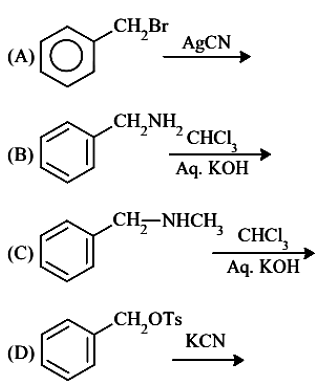
The structures of major products A , B and C in the following reaction are sequence
Match List I with List II :